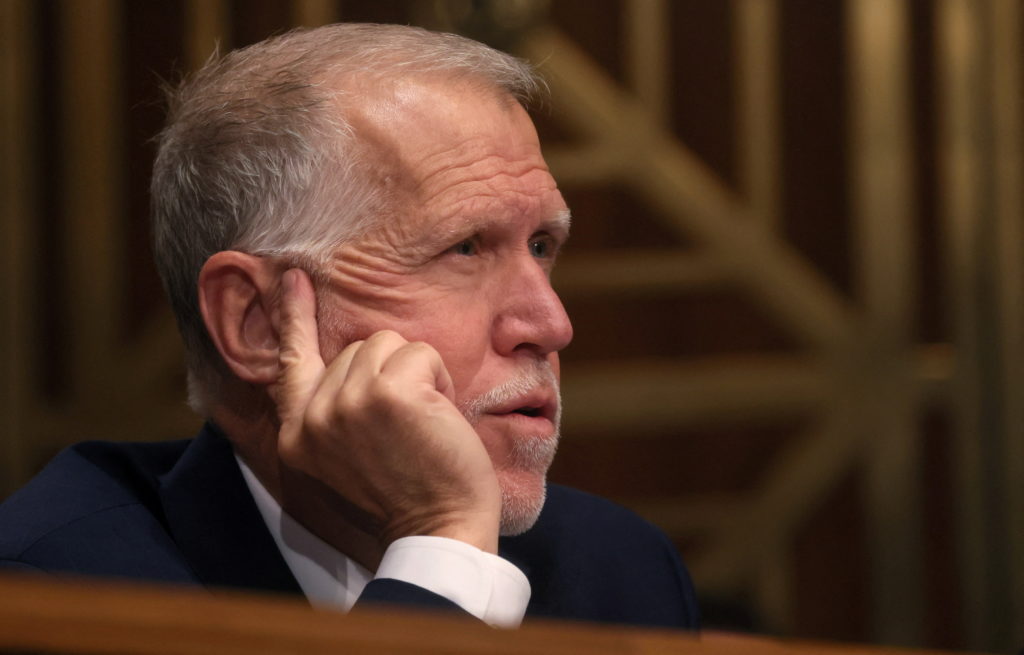
Four Republican senators joined Democrats in demanding that Trump reverse his Russian diesel deal, saying he skipped steps the law requires.
The bipartisan group said on Sunday, Oct. 11, that the license letting Russian diesel into the U.S. hands Moscow money while it keeps attacking Ukraine, and that Congress was never consulted.
Susan Collins, Lisa Murkowski, Thom Tillis and John Curtis signed on. Collins said she co-sponsored the sanctions law Trump “recently signed but is now not following.”
October 12, 2026 · Eight stories, illustrated
- Sen. · MaineSusan Collins
Co-sponsored the sanctions law Trump “recently signed but is now not following.”
- Sen. · AlaskaLisa Murkowski
- Sen. · North CarolinaThom Tillis
Says there is a legitimate case the deal breaks the law, and tied it to funding talks.
- Sen. · UtahJohn Curtis
Rep. Thomas Massie of Kentucky backed it and urged lifting sanctions on other petroleum products, copper and aluminum too.
The whole group: AP counted six signers; Politico counted seven, adding Sen. Ron Wyden, an Oregon Democrat.
“If the president wants my support the president needs to understand this is a problem, and I’m not the only Republican concerned with this.”Sen. Thom Tillis of North Carolina, tying the deal to funding talks
- 45 days
- The president must consult four congressional committees 45 days before certifying.
- 90 more
- Then wait 90 more days.
- 290 · 67
- Overriding a Trump veto takes 290 House votes and 67 senators.
The senators say the administration never consulted Congress or gave the explanation the law requires, and that the deal hands Moscow money while it keeps attacking Ukraine.
Read the reporting

Trump said Russia and Ukraine agreed to an immediate energy ceasefire, which Moscow has not confirmed.
Trump announced it on Sunday, Oct. 11, and published no terms. A White House official told Axios the proposal covers only oil refineries on both sides, not power plants or the electric grid, and that Russia was still considering it.
An energy ceasefire is a pause limited to strikes on fuel and power sites, not a halt to the wider war.
- Oil refineriesOn both sides
- Power plantsNot covered
- The electric gridNot covered
After the announcement, Ukrainian officials reported Russian attacks on power facilities in Kyiv and Kharkiv.
No written list exists yet for this deal, and the refinery-only scope would not cover the power plants Ukraine said Russia hit.
“If President Trump negotiated it with Putin, please tell us when the ceasefire begins. We are ready, and we will accept it.”Volodymyr Zelensky, Ukraine’s president, who said the deal was news to him. Christopher Miller of the Financial Times reported that Zelensky’s office had no information about it.
Russia dated its start to March 18; Ukraine, to March 25.
On March 25 the Kremlin published a list of protected sites naming refineries and electricity infrastructure together. Attacks on protected sites were still reported.Moscow paused strikes on Kyiv until Feb. 1; Kyiv offered a nationwide week from Jan. 30.
Zelensky said Russia broke it on Feb. 3.Still open: whether Russia accepts at all, and when any halt would start.
Read the reporting

A projectile hit Riyadh’s airport again on Sunday, Oct. 11, killing one person, a day after a strike that NBC says killed at least 13.
Sunday’s strike on King Khalid International Airport killed a Pakistani resident and injured 11, Saudi Arabia’s civil aviation authority said. NBC raised Saturday’s toll after an injured Indian national died; CBS and The Washington Post reported 12.
Houthi spokesman Yahya Saree warned that Saudi airports and airspace are now targets.
- at least 13
- killed, per NBC, citing Saudi aviation authorities, after an injured Indian national died
- 12
- killed, per CBS and The Washington Post
An American was among the dead. GACA, Saudi Arabia’s civil aviation authority, counted 309 injured.
- One
- killed, a Pakistani resident, and 11 injured, GACA said
The airport stays closed.
“Constitute a theatre of operations for our forces.”Yahya Saree, the Houthi spokesman, of Saudi Arabia’s airports and airspace
- FAAU.S. airlines: use caution flying over, landing and taking offThrough Dec. 10
- U.S. MissionAmericans: avoid Riyadh’s airport
- U.S. governmentEmployees: special approval to use airports in Riyadh, Jeddah or Dammam
passengers a day used King Khalid in 2025: 40.8 million in the year, per GASTAT, Saudi Arabia’s statistics agency. CNN counted more than 600 cancelled flights.
Saturday’s strike was the deadliest attack in Saudi Arabia since May 2015, per the BBC; Houthi-claimed attacks there on Thursday, Oct. 8, killed three, GACA said.
Still open: Trump said the U.S. is considering joining Saudi military operations against the Houthis. No mission, forces or timeline has been announced. The U.S. bombed the Houthis for three months last year, which NBC’s expert Fawaz Gerges says failed to make them stand down.
Read the reporting

A U.S. fighter jet disabled a Panama-flagged cargo ship trying to evade the blockade of Iran’s ports, Central Command says.
The jet struck the stern of the M/V Ocean Molica, also known as Arika Sun, in the Gulf of Oman on Sunday, Oct. 11, the command said. It says the ship ignored warnings, and that the strike knocked out its engines without harming the crew.
It is the fourth ship U.S. forces have disabled since the blockade resumed, the command says.
- In force: began April 13, lifted June 18, resumed Tuesday, July 14
- Lifted, after the U.S. and Iran announced a memorandum to end the war
- 1Belma, tanker, July 15
- 2Lavine, tanker, July 24
- 3Vela Nova, cargo ship, Aug. 11
- 4Ocean Molica, cargo ship, Oct. 11 · this one, in the Gulf of Oman
135 more ships turned back since the blockade resumed: disabling is the rare step, about one for every 34 turned back. The command does not date them, so they are not drawn. Its Oct. 5 tally was three disabled and 130 turned back.
Separately, the command reported destroying 13 commercial vessels in the 12 weeks to Oct. 5. It gave no dates, so they have no marks. The blockade covers ships entering or leaving Iranian ports and coastal areas, not all traffic through the Strait of Hormuz.
Allows force against neutral ships resisting capture for blockade-running.
Cites no legal basis for this strike and names no destination for the ship or crew.
The squeeze shows in oil: Iran loaded no crude onto tankers in September, against 250,000 barrels a day in August, by Bloomberg’s preliminary tanker tracking.
Still open: where the ship and its crew go; the command named no destination.
Read the reporting
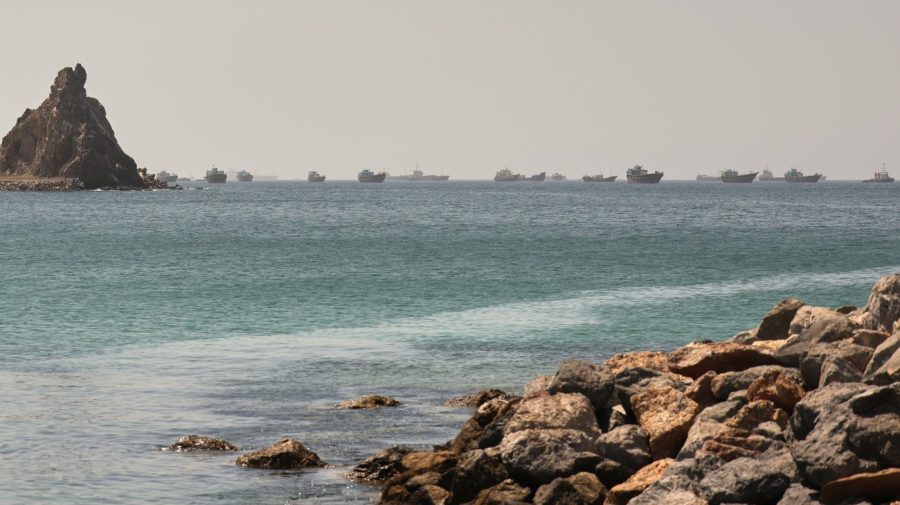
Iran’s security chief called the U.S. reply to Tehran’s plan to end the war and reopen the Strait of Hormuz insufficient, and said Iran has stopped responding.
Mohsen Rezaei, head of Iran’s Supreme National Security Council, the body that sets its war and security policy, said on Sunday, Oct. 11, that the U.S. had accepted some of Iran’s conditions but had to clarify others. He did not say which.
If intense fighting resumes, Rezaei said, Iran could hit regional undersea cables, data centers, AI facilities and other sites.
crossings a day, before the war, IMF PortWatch
visible crossings a day, Hormuz.now
January’s 58.5 is IMF PortWatch’s figure; the Oct. 5–11 average of 9.7 is Hormuz.now’s, which counts only visible crossings. Read the fall as approximate. Faint hulls repeat January’s count; the last hull in each field is drawn partial.
Ships are not oil: before the war began Feb. 28, about 21 million barrels of oil a day moved through the strait, per Kpler. Iran’s offer would reopen the strait within seven days, but only once its terms are met. On Wednesday, Oct. 7, its Foreign Ministry promised a reply through mediators, including Qatar.
- Safe routes
- Shipowners’ group BIMCO wants mine-free routes and safety assurances from both Iran and the U.S. before ships sail.
- Insurance
- War insurance is priced ship by ship; in August some stranded owners could not get adequate cover.
- Time
- After the short-lived June memorandum, BIMCO estimated shipping would take a couple of months to recover once safe passage was confirmed.
The last deal: the war’s only prior deal, a memorandum announced June 14, lifted the U.S. blockade of Iranian ports on June 18; it collapsed in July after Iran fired on ships off its approved routes, per Reuters, and the blockade resumed July 14.
Read the reporting
An advocacy group counts 52 maternity wards closed since the July 2025 Medicaid cuts, and two of the hospitals cited the law’s coming changes.
Protect Our Care, a health-care advocacy group, counted 52 hospital maternity wards closed since HR1, the 2025 Republican tax-and-spending law that cuts Medicaid funding and tightens eligibility, was announced in July 2025. Its count does not show that the law caused every closure.
- Closed since July 2025
- 52 hospital maternity wards
- Announced
- Eight more with closures announced
- Named the law
- Two hospitals, both citing upcoming federal Medicaid changes, not cuts they had already felt
- For scale, a different count
- 67 hospitals dropped obstetric care in 2024 alone, before the law, the University of Minnesota counted
The tally alone does not show why each ward closed. Medicaid pays for about 40% of U.S. births.
Two hospitals did name it. Centra Southside Community Hospital in Farmville, Virginia, and St Mary’s Sacred Heart Hospital in Lavonia, Georgia, both cited upcoming federal Medicaid changes when they shut their units. Many of the law’s changes have not yet hit.
About an hour’s drive, to Centra Virginia Baptist Hospital in Lynchburg.
Centra Southside delivered fewer than 200 babies in 2024, under four a week, and also reported a shortage of obstetricians.About 30 minutes to the nearest delivery hospital, Sacred Heart says.
CBS reported 45-90 minute trips to Athens or Greenville.“Losing these services means fewer places to deliver safely and fewer options for pregnancies requiring specialized care.”Erin Jones, March of Dimes
Still open: how many of the 52 trace to the law. Hospitals and maternal-health advocates warn that the cuts will speed these losses, most of all in rural areas.
Read the reporting
Average hourly pay grew 3% in the year to September, while prices rose 3.4% in the year to August.
Average hourly earnings for U.S. private-sector workers rose 3% over the year ending in September, per the Bureau of Labor Statistics. Consumer inflation was 3.4% over the year ending in August; September’s figure is not out yet, so the headline numbers cover different months.
Year to August 2026Matched by month
- Hourly pay
- +$3.10per $100 of pay · 3.1%
- Prices
- +$3.40per $100 of spending · 3.4%
- Gap
- 0.3percentage point
By the Bureau of Labor Statistics’ own inflation-adjusted figure, an average hour of work bought 0.3% less in August 2026 than in August 2025.
“Can buy less with a sort of average hour of work than they could a year before.”Labor economist Aaron Sojourner, of what people’s pay now buys
- June3.4%
- July3.2%
- August3.1%
- September3%
September’s 3% is the slowest pace since May 2021, The Wall Street Journal and CNBC reported. September’s inflation figure is not out yet.
By the BLS series, inflation-adjusted hourly pay was below its year-earlier level in every month from April through August 2026. The last such stretch ran 25 months, from April 2021 to April 2023.
- Up 0.6%
- The average workweek, August 2025 to August 2026: people worked more hours.
- Up 0.3%
- Real weekly earnings over the same year, because the longer hours outweighed the hourly loss.
- 4.1%
- Atlanta Fed median wage growth in August, for the same workers tracked a year apart, up from 3.8% in July.
Read the reporting
Texas Tech screens course materials with AI for compliance with its content limits, and UT Austin is ending four race, ethnicity and gender majors.
Two Texas public university systems are narrowing what can be taught, from single syllabi to whole degree programs, The Atlantic reports. At Texas Tech, the limits come from the university’s own leaders, not from state law.
- Every course’s materials
must pass the AI-assisted review.
- The software flags
anything that may break the university’s limits on what can be taught.
- No named judge
The published rules name no final judge and no appeal deadline. Professor Alan Barenberg said he was told he could not appeal an AI flag.
Texas Tech said its written guidance expressly protects instruction needed for licensure and patient care, but only if faculty disclose that material to a regents’ committee that can then order changes, per the April 9 memo.
Faculty suits allege the rules reached teaching about racial disparities, texts that discuss sexuality, and clinical teaching on transgender patients. A lawsuit from the American Association of University Professors alleges Texas Tech medical faculty were told not to treat transgender patients for any condition while a medical student was present.
SB 37, a 2025 law, lets regents review general-education courses at least once every five years, first by Jan. 1, 2027.
Lawmakers stripped proposed bans on race, gender and sexuality topics before it passed.Chancellor Brandon Creighton’s Dec. 1, 2025 directive, and guidelines issued April 9, 2026.
Both threaten discipline for faculty who do not comply.- Africana studies
- Mexican American and Latino studies
- Women’s and gender studies
- Race and migration studies
Current students can finish their degrees; only new enrollment ends, UT spokesperson Mike Rosen said. UT did not give enrollment counts.
Still open: the medical-school accreditor’s 2026–27 standards, LCME Element 7.6, require teaching on bias and health-care disparities. Accreditation is what lets graduates sit for licensing exams.