News news5 stories
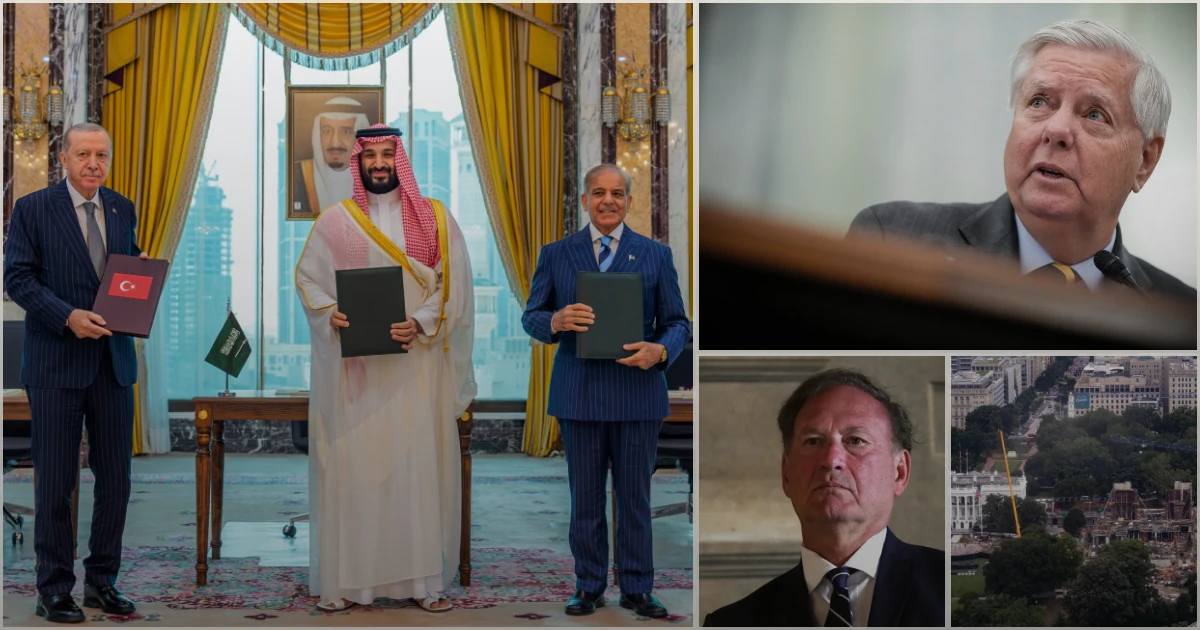
The three states span the eastern Mediterranean, Arabian Peninsula and South Asia; Pakistan is the only one with nuclear weapons.
What the pact does—and does not—promise
Saudi Arabia and Pakistan signed a bilateral mutual-defense pact in September 2025; the new agreement adds Turkey, which has NATO’s second-largest military by personnel. It says it does not replace existing commitments, including Turkey’s NATO obligations, but gives no public trigger, command structure or troop commitment. Analysts quoted by AP said diplomacy, arms development and technology transfer are more likely near-term effects than mass deployments. The nuclear question is also deliberately unresolved: Pakistan’s arsenal raises the pact’s deterrent value, but the text does not say its nuclear guarantee extends to either partner.
The bill threatens tariffs of up to 100% against major buyers of Russian energy—but it still needs the House, and enforcement would hinge on waivers and buyer compliance.
Would the sanctions work?
Not immediately. Senate passage does not create tariffs: the House must pass the bill, the president must sign it and the administration must decide whom to penalize. Broad presidential waivers could substantially limit enforcement. If Washington actually forced India and China to choose between Russian oil and U.S. market access, Moscow could lose revenue or offer deeper discounts. But removing a supplier responsible for roughly one-tenth of world crude exports could also lift global prices, and Russia has already shown it can reroute oil through intermediaries and a shadow fleet. Natural gas is harder to redirect because pipelines and LNG terminals constrain where it can go.
Justice Samuel Alito, 76, said he is “obviously” staying for the court term that begins in October. The statement follows weeks of speculation triggered by an erroneous NPR retirement story that was quickly retracted.
The comparison explains why the U.S. is unusual among wealthy democracies; it does not answer whether a president can change a constitutional and statutory rule without Congress.
Quick bites6
The Strategic Petroleum Reserve has no single countdown
GAOFuel pricesHow unusual is this release?
The 2022 release of 180 million barrels was the SPR’s largest drawdown, making the current planned 172-million-barrel release nearly as large. Since 1985, DOE has released more than 500 million barrels from the reserve, with nearly 70% of all releases occurring from 2014 through 2025.
Will the barrels come back?
DOE structured the 2026 action as an exchange rather than a permanent sale: companies receive crude now and owe barrels back later, generally with an additional premium. That makes the refill schedule part of the policy. A promised return is not the same as oil already underground, and GAO says deferred maintenance and cavern problems can constrain how much usable oil the government can deliver even when the inventory number looks adequate.
ICE controls body-camera releases
APICE raidsICE says field officers nationwide will have body cameras by the end of September. Its policy, however, says footage will be released only when doing so is in the agency’s “best interests.”
Who decides what the public sees?
A committee of senior ICE officials and lawyers reviews footage of incidents involving death or serious injury and recommends whether to release it. If the agency decides release serves its interests, it generally aims to finish the review within 72 hours. The ICE director may block or indefinitely delay publication under unspecified “specific and compelling circumstances,” and any released video must obscure officers’ faces and other identifying information.
That distinction is the accountability issue: cameras can preserve evidence for investigators and lawsuits even when footage is not public, but the policy does not create an automatic public-release rule or an independent decision-maker. The people being recorded cannot themselves trigger publication.
Pentagon revokes Kendall’s clearance
APThe Pentagon revoked former Air Force Secretary Frank Kendall’s eligibility to access classified information and barred him from sensitive positions, accusing him of an unauthorized disclosure about Air Force One. Kendall said he was “completely mystified” and had not been told what information the government considered classified.
The dispute follows reporting that the Qatari-donated replacement aircraft lacked some advanced defensive systems. Kendall had said the accelerated conversion left too little time for “all the normal Air Force One modifications” and that he was surprised the plane was used outside the United States. The Pentagon has not identified the allegedly classified statement or the outlet involved, and it did not say whether it referred Kendall for prosecution.
The immediate penalty is administrative, not a criminal conviction: it removes Kendall’s eligibility for future classified work or sensitive government and contractor roles. Unless the Pentagon identifies the classified statement, names the outlet or discloses a criminal referral, the clearance revocation will remain the government’s only public action against Kendall.
Senate confirms Todd Blanche as attorney general, 50–49
APThe Senate confirmed President Trump’s former personal lawyer in an overnight vote. Republicans Susan Collins and Lisa Murkowski joined Democrats in opposition; Bill Cassidy supplied the decisive support after saying Blanche was better positioned than another nominee to push back on Trump when necessary.
Blanche had already run the Justice Department in an acting capacity since Pam Bondi’s April departure. His nomination nearly failed over a proposed $1.8 billion compensation fund for Trump allies and a settlement provision shielding Trump and his family from IRS audits. Blanche promised in writing to abandon the fund and narrow the tax protection, unlocking support from Republican holdouts.
Kalshi carried a confirmation market while the vote was unresolved, but the 50–49 result now outranks—and settles—the forecast. The first concrete test is whether Blanche keeps the two written commitments that secured confirmation: abandoning the compensation fund and narrowing the tax protection. The vote did not resolve how he will handle investigations involving Trump’s opponents.
Homeowners sue over New York City’s pied-à-terre tax rollout
CNNThree homeowners sued Mayor Zohran Mamdani and the city finance commissioner, challenging a supplemental tax roll that listed more than 900,000 properties and notices sent to some residents. The complaint does not seek to strike down the underlying surcharge.
The annual surcharge applies only to qualifying non-primary residences. For 2026–27 and 2027–28, one- to three-family homes enter at a city market value of $5 million, with rates from 0.8% to 1.3%; condos and co-ops enter at $1 million, with rates from 4% to 6.5% under the city’s separate valuation rules. Primary residences used by an owner, tenant or immediate family member are exempt.
The Department of Finance says only about 17,000 owners received “may be subject” letters and that appearing on the much larger public roll does not mean a bill is due. The lawsuit argues that the rollout wrongly put the burden on residents to prove exemptions and unnecessarily exposed names and addresses. The city extended the exemption deadline to Sept. 18; any surcharge due appears on the Jan. 1, 2027 property-tax bill.
Judge orders Pentagon to resume onshore-wind reviews
STATELINEA federal judge ordered the Defense Department to restart national-security reviews for onshore wind projects after the process slowed beginning in August 2025 and stopped entirely in April.
The Pentagon reviews proposed turbines during the Federal Aviation Administration process because tall structures can interfere with military radar, training routes and other operations. Developers and the military normally negotiate mitigation rather than treat every conflict as a veto. The industry plaintiffs said the freeze stalled at least 106 verified projects across 21 states—about 29 gigawatts of proposed capacity and $47 billion in investment.
The order does not approve those wind farms. It requires the Pentagon to resume the case-by-case process so projects can receive conditions, rejection or clearance on the record. Wind currently supplies about 10% of U.S. electricity, so a nationwide review stoppage affects far more capacity than a single permit dispute.
Elections10 races
The midterms · 87 days out · November 3, 2026
D or R take the House / Senate?
U.S. House: chance Democrats take it, Polymarket 88%, Kalshi 85%. U.S. Senate: chance Democrats take it, Polymarket 46%, Kalshi 47%. Full day-by-day figures are in the table below.
No House district is priced by either book — the House appears here as chamber control only
Each bar is one contract: will Democrats control this chamber after the 2026 midterms. The Republican share is the arithmetic complement of that price, not a separately traded market. Republicans hold the House and the Senate, so the figure printed there is the chance Democrats take them. Two venues price each contract; where they differ the lighter wedge is how far apart they are, and the panel on the right is the week.
- two venues, priced separately
- shaded = how far apart they are
- 50% — control flips here
- where it stood 7 days ago
- the last 7 days, on its own scale
- week panel: one line a party
The week panel draws one line per party, crossing where control does. Only the Democratic line is a traded price: the Republicanline is its arithmetic complement, the same mirror the bar’s other half is, and not a second market agreeing with the first. The shading around each line is how far apart the two venues are.
Market prices are not forecasts with error bars; they are the last price two sets of traders agreed on. The gap between the venues is the closest thing here to a stated uncertainty. The bar runs 0–100%; the week panel beside it is zoomed to its own data and prints its top and bottom, because a two-point move is four pixels wide on a 0–100% scale and was previously drawn there anyway.
The two chambers are not the same kind of bet. The House sits far enough from the flip line that the venues’ disagreement barely matters; the Senate sits close enough that their 3.0pp gap / 1.0pp gap is a meaningful share of the distance to 50%.
Who is defending the House and the Senate is sourced, not remembered — House, 2026-07-23 issue: the NDAA passed “216-212, with six Democrats joining a unified Republican majority.”; Senate, 2026-08-10 issue: “Republicans hold 53 of the Senate's 100 seats.”
Volume is each venue's own reported figure — Polymarket in USD, Kalshi in contracts. They are not a common unit, so read the weighting as a tilt, not a conversion.
| Day | U.S. House · Polymarket | U.S. House · Kalshi | U.S. Senate · Polymarket | U.S. Senate · Kalshi |
|---|---|---|---|---|
| 7 days ago | 86% | 84% | 45% | 46% |
| 6 days ago | 86% | 83% | 45% | 46% |
| 5 days ago | 86% | 83% | 45% | 47% |
| 4 days ago | 87% | 83% | 45% | 47% |
| 3 days ago | 87% | 84% | 45% | 44% |
| 2 days ago | 88% | 83% | 46% | 47% |
| yesterday | 88% | 85% | 46% | 46% |
| today | 88% | 85% | 46% | 47% |
3 closest races
iTexas Senate generalTexas Senate
POLYMARKET: Texas Senate — general election
Republican Ken Paxton faces Democrat James Talarico. The market measures the exact November winner, not either party’s national Senate total.
A Republican-held seat Democrats hope to make competitive
Two markets, one question
Texas Senate general
Aug 8, 8:35 AM CT
widest venue gap 1.0pp- Polymarket, solid
- Kalshi, dashed
- shaded = the gap between them
Texas Senate general. Ken Paxton (R): Polymarket 51.0%, Kalshi 50.5%; James Talarico (D): Polymarket 49.5%, Kalshi 48.5%. Widest disagreement between the two venues: 1.0pp. Full history is in the table below.
7 days agoMarket-implied chance of winning, out of 100 — prices, not polls. Source: Polymarket · Kalshi.
Prices are what each venue’s traders were paying, right-aligned to the snapshot: the last sample is today, the one before it yesterday. Every series here is 8 samples long.
Money-weighted: Ken Paxton 51% · James Talarico 49%. Volume is each venue's own reported figure — Polymarket in USD, Kalshi in contracts. They are not a common unit, so read the weighting as a tilt, not a conversion.
Ken Paxton (R)7 days agoPolymarket$370K51.5%Kalshi4.2M contracts · 50%/51%54.0%venue gap2.5pp7-day move-0.5ppJames Talarico (D)7 days agoPolymarket$308K47.5%Kalshi3.3M contracts · 48%/49%47.0%venue gap0.5pp7-day move+2.0ppEvery sample behind the chart. Texas Senate general, snapshot Aug 8, 8:35 AM CT. Day Ken Paxton · Polymarket Ken Paxton · Kalshi James Talarico · Polymarket James Talarico · Kalshi 7 days ago 51.5% 54.0% 47.5% 47.0% 6 days ago 52.5% 55.0% 47.5% 46.0% 5 days ago 52.5% 55.0% 47.5% 47.0% 4 days ago 51.5% 55.0% 48.5% 47.0% 3 days ago 51.5% 52.0% 48.5% 49.0% 2 days ago 51.5% 52.0% 49.5% 49.0% yesterday 51.5% 52.0% 49.5% 49.0% today 51.0% 50.5% 49.5% 48.5% mOhio Senate generalOhio Senate
POLYMARKET: Ohio Senate — general election
Democrat Sherrod Brown faces Republican Sen. Jon Husted. Ohio has leaned Republican in recent statewide elections, but Brown previously won three Senate terms there.
A special election for a Republican-held seat
Two markets, one question
Ohio Senate general
Aug 8, 8:35 AM CT
widest venue gap 1.0pp- Polymarket, solid
- Kalshi, dashed
- shaded = the gap between them
Ohio Senate general. Sherrod Brown (D): Polymarket 51.5%, Kalshi 50.5%; Jon Husted (R): Polymarket 49.5%, Kalshi 49.5%. Widest disagreement between the two venues: 1.0pp. Full history is in the table below.
7 days agoMarket-implied chance of winning, out of 100 — prices, not polls. Source: Polymarket · Kalshi.
Prices are what each venue’s traders were paying, right-aligned to the snapshot: the last sample is today, the one before it yesterday. Every series here is 8 samples long.
Money-weighted: Sherrod Brown 51% · Jon Husted 50%. Volume is each venue's own reported figure — Polymarket in USD, Kalshi in contracts. They are not a common unit, so read the weighting as a tilt, not a conversion.
Sherrod Brown (D)7 days agoPolymarket$70.7K51.5%Kalshi279K contracts · 50%/51%54.0%venue gap2.5pp7-day move0.0ppJon Husted (R)7 days agoPolymarket$57.9K50.5%Kalshi422K contracts · 49%/50%48.0%venue gap2.5pp7-day move-1.0ppEvery sample behind the chart. Ohio Senate general, snapshot Aug 8, 8:35 AM CT. Day Sherrod Brown · Polymarket Sherrod Brown · Kalshi Jon Husted · Polymarket Jon Husted · Kalshi 7 days ago 51.5% 54.0% 50.5% 48.0% 6 days ago 50.5% 53.0% 50.5% 47.0% 5 days ago 50.5% 54.0% 50.0% 48.0% 4 days ago 50.5% 52.0% 49.5% 48.0% 3 days ago 51.5% 52.0% 50.5% 48.0% 2 days ago 51.5% 53.0% 49.5% 48.0% yesterday 51.5% 50.0% 49.5% 50.0% today 51.5% 50.5% 49.5% 49.5% jAlaska Senate generalAlaska Senateone book
ALASKA DIVISION OF ELECTIONS: Alaska Senate — primary still ahead
Former Democratic Rep. Mary Peltola and Republican Sen. Dan Sullivan are the nationally watched candidates, but they have not yet secured November ballot spots. Alaska’s 16-candidate, nonpartisan primary is Aug. 18; the top four advance to a ranked-choice general election. The odds below price the eventual November winner, not merely who finishes first in the primary.
The top-four primary is Aug. 18; the displayed markets price the eventual November winner
The other 7 races
Senate3 of 6
kIowa Senate generalIowa Senate
POLYMARKET: Iowa Senate — general election
Republican Ashley Hinson faces Democrat Josh Turek for an open seat. The individual-race market is distinct from the national Senate-control contracts shown at the top of this section.
An open-seat contest
Two markets, one question
Iowa Senate general
Aug 8, 8:35 AM CT
widest venue gap 3.0pp- Polymarket, solid
- Kalshi, dashed
- shaded = the gap between them
Iowa Senate general. Ashley Hinson (R): Polymarket 56.5%, Kalshi 59.5%; Josh Turek (D): Polymarket 44.5%, Kalshi 41.5%. Widest disagreement between the two venues: 3.0pp. Full history is in the table below.
7 days agoMarket-implied chance of winning, out of 100 — prices, not polls. Source: Polymarket · Kalshi.
Prices are what each venue’s traders were paying, right-aligned to the snapshot: the last sample is today, the one before it yesterday. Every series here is 8 samples long.
Money-weighted: Ashley Hinson 59% · Josh Turek 42%. Volume is each venue's own reported figure — Polymarket in USD, Kalshi in contracts. They are not a common unit, so read the weighting as a tilt, not a conversion.
Ashley Hinson (R)7 days agoPolymarket$83.4K56%Kalshi553K contracts · 59%/60%58%venue gap2.0pp7-day move+0.5ppJosh Turek (D)7 days agoPolymarket$87.8K44.5%Kalshi460K contracts · 41%/42%43.0%venue gap1.5pp7-day move0.0ppEvery sample behind the chart. Iowa Senate general, snapshot Aug 8, 8:35 AM CT. Day Ashley Hinson · Polymarket Ashley Hinson · Kalshi Josh Turek · Polymarket Josh Turek · Kalshi 7 days ago 56.0% 58.0% 44.5% 43.0% 6 days ago 55.5% 58.0% 45.5% 43.0% 5 days ago 55.5% 58.0% 45.5% 43.0% 4 days ago 55.5% 59.0% 45.0% 43.0% 3 days ago 56.0% 58.0% 45.0% 43.0% 2 days ago 56.5% 60.0% 44.5% 40.0% yesterday 56.5% 60.0% 44.5% 41.0% today 56.5% 59.5% 44.5% 41.5% hMaine Senate generalMaine Senateone book
AP: Maine Senate — general election
Democrat Troy Jackson faces Republican Sen. Susan Collins. Maine is central to Democrats’ attempt to erase the GOP’s Senate majority.
A top Democratic pickup opportunity
lMichigan Senate generalMichigan Senateone book
AP: Michigan Senate — general election
Democrat Abdul El-Sayed faces Republican Mike Rogers. AP called the Aug. 4 Democratic primary for El-Sayed after he led Haley Stevens by just under one percentage point; this is now a general-election forecast, not a primary market.
El-Sayed won the Democratic primary by less than one point
Governors4
oGeorgia governor generalGeorgia governorone book
AP: Georgia governor — general election
Democrat Keisha Lance Bottoms faces Republican Rick Jackson. Jackson won the Republican runoff after spending more than $93 million of his own money; Bottoms won the Democratic primary outright.
An open-seat contest in a closely divided state
pNevada governor generalNevada governor
POLYMARKET: Nevada governor — general election
Democrat Aaron Ford faces Republican Gov. Joe Lombardo. Market prices are a real-money snapshot of this exact contest, not a substitute for polling or a guarantee of the result.
A Democratic challenger against a Republican incumbent
Two markets, one question
Nevada governor general
Aug 8, 8:35 AM CT
widest venue gap 3.5pp- Polymarket, solid
- Kalshi, dashed
- shaded = the gap between them
Nevada governor general. Aaron Ford (D): Polymarket 52%, Kalshi 54%; Joe Lombardo (R): Polymarket 48.0%, Kalshi 44.5%. Widest disagreement between the two venues: 3.5pp. Full history is in the table below.
7 days agoMarket-implied chance of winning, out of 100 — prices, not polls. Source: Polymarket · Kalshi.
Prices are what each venue’s traders were paying, right-aligned to the snapshot: the last sample is today, the one before it yesterday. Series run 5–8 samples because the venues listed these markets on different days; a short line starts late rather than being stretched across a week it was never priced over.
Money-weighted: Aaron Ford 54% · Joe Lombardo 45%. Volume is each venue's own reported figure — Polymarket in USD, Kalshi in contracts. They are not a common unit, so read the weighting as a tilt, not a conversion.
Aaron Ford (D)7 days agoPolymarket$11.7K56.5%Kalshi98.5K contracts · 53%/55%—venue gap—7-day move-4.5ppJoe Lombardo (R)7 days agoPolymarket$33.5K44.5%Kalshi158K contracts · 44%/45%—venue gap—7-day move+3.5ppEvery sample behind the chart. Nevada governor general, snapshot Aug 8, 8:35 AM CT. Day Aaron Ford · Polymarket Aaron Ford · Kalshi Joe Lombardo · Polymarket Joe Lombardo · Kalshi 7 days ago 56.5% — 44.5% — 6 days ago 57.0% — 43.5% 44.0% 5 days ago 55.0% — 44.0% 44.0% 4 days ago 55.0% 57% 45.5% 43.0% 3 days ago 52.5% 57% 48.0% 45.0% 2 days ago 52.0% 55% 48.0% 48.0% yesterday 52.0% 55% 48.0% 44.0% today 52.0% 54% 48.0% 44.5% gOhio governor generalOhio governor
POLYMARKET: Ohio governor — general election
Republican Vivek Ramaswamy faces Democrat Amy Acton. Market prices below are snapshots, not polls; they can move with news, liquidity and trader composition.
Open-seat general election
Two markets, one question
Ohio governor general
Aug 8, 8:35 AM CT
widest venue gap 5.0pp- Polymarket, solid
- Kalshi, dashed
- shaded = the gap between them
Ohio governor general. Vivek Ramaswamy (R): Polymarket 55.5%, Kalshi 50.5%; Amy Acton (D): Polymarket 45.0%, Kalshi 49.5%. Widest disagreement between the two venues: 5.0pp. Full history is in the table below.
7 days agoMarket-implied chance of winning, out of 100 — prices, not polls. Source: Polymarket · Kalshi.
Prices are what each venue’s traders were paying, right-aligned to the snapshot: the last sample is today, the one before it yesterday. Every series here is 8 samples long.
Money-weighted: Vivek Ramaswamy 51% · Amy Acton 49%. Volume is each venue's own reported figure — Polymarket in USD, Kalshi in contracts. They are not a common unit, so read the weighting as a tilt, not a conversion.
Vivek Ramaswamy (R)7 days agoPolymarket$57.3K56%Kalshi567K contracts · 50%/51%53%venue gap3.0pp7-day move-0.5ppAmy Acton (D)7 days agoPolymarket$59.4K45.5%Kalshi376K contracts · 49%/50%47.0%venue gap1.5pp7-day move-0.5ppEvery sample behind the chart. Ohio governor general, snapshot Aug 8, 8:35 AM CT. Day Vivek Ramaswamy · Polymarket Vivek Ramaswamy · Kalshi Amy Acton · Polymarket Amy Acton · Kalshi 7 days ago 56.0% 53.0% 45.5% 47.0% 6 days ago 56.0% 53.0% 44.0% 49.0% 5 days ago 56.0% 51.0% 44.0% 48.0% 4 days ago 56.0% 52.0% 44.0% 47.0% 3 days ago 56.0% 51.0% 44.0% 50.0% 2 days ago 55.5% 50.0% 45.0% 50.0% yesterday 55.5% 51.0% 45.0% 50.0% today 55.5% 50.5% 45.0% 49.5% nWisconsin governor Democratic primaryWisconsin governorone book
AP: Wisconsin governor — nominees not yet settled
Wisconsin votes Tuesday, Aug. 11. Democratic socialist Francesca Hong faces Milwaukee County Executive David Crowley and other Democrats; Republican Tom Tiffany faces nominal opposition. At 8:35 a.m. CT on Aug. 8, Polymarket priced Hong at 95.3% and Crowley at 4.9% to win the Democratic nomination. The rows below show that Democratic-primary market only; they do not price the Republican primary or the November general election.
Hong leads the Democratic field; Tiffany faces nominal Republican opposition
Two markets, one question
Wisconsin governor Democratic primary
Aug 8, 8:35 AM CT
one venue only- Polymarket, solid
Wisconsin governor Democratic primary. Francesca Hong (D): Polymarket 95.3%; David Crowley (D): Polymarket 4.9%. Full history is in the table below.
7 days agoMarket-implied chance of winning, out of 100 — prices, not polls. Source: Polymarket.
Prices are what each venue’s traders were paying, right-aligned to the snapshot: the last sample is today, the one before it yesterday. Every series here is 8 samples long.
Every sample behind the chart. Wisconsin governor Democratic primary, snapshot Aug 8, 8:35 AM CT. Day Francesca Hong · Polymarket David Crowley · Polymarket 7 days ago 96.05% 3.55% 6 days ago 96.35% 2.95% 5 days ago 96.45% 3.30% 4 days ago 94.70% 5.70% 3 days ago 90.20% 8.20% 2 days ago 91.50% 8.45% yesterday 94.65% 5.25% today 95.30% 4.90%
“Still in doubt” means no leader above 80% on either book. Prices captured Aug 8, 8:35 AM CT. These are trader-implied estimates, not polls. Separate contracts trade independently, so opposing prices may not add to exactly 100%.