Trump orders the Pentagon to cut U.S.–South Korea military drills, granting a demand North Korea has made for decades
In a Sunday, Aug. 16 post, he told Defense Secretary Pete Hegseth to "substantially reduce" the joint exercises, calling them costly and "hostile" to Pyongyang.
Trump wrote on Truth Social that he is "not happy with the fact that the United States has, long ago, agreed" to hold the joint exercises, and said he had directed the Pentagon to scale them back. He cited his "very good relationship" with North Korean leader Kim Jong Un, and praised North Korea in the same post. The post also scolded South Korea for what Trump described as a failure to help denuclearize Iran. No timeline, target size, or list of which exercises would be trimmed accompanied the announcement.
What Trump's last drill freeze, in 2018, actually changed:
- He called the drills "war games" and "provocative" at the June 12, 2018 Singapore summit with Kim; the Pentagon suspended Ulchi Freedom Guardian six days later, on June 18.
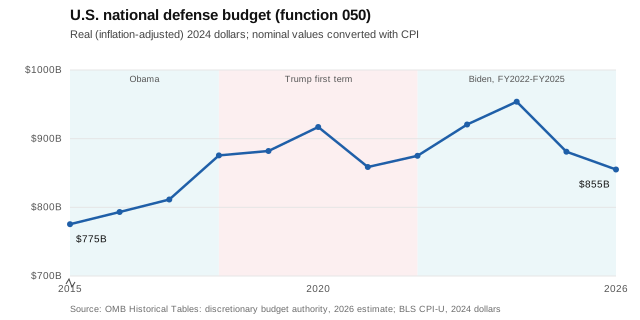
- The Pentagon put the cost of that one canceled exercise at about $14 million — roughly 0.002% of that year's $700 billion defense budget.
- Field training stayed shrunk or renamed for four years; full-scale exercises did not return until August 2022, under Ulchi Freedom Shield.
- North Korea ran no nuclear test during the pause, and more than a dozen rounds of missile tests in 2019, the year the Hanoi summit collapsed.
SEMI-RELATED
Ruben Gallego (Sen-D Arizona) compares boosting Iran war funding to "giving a drunk more money and hoping that they'll stop drinking"
Trump faulted Seoul for not backing him on Iran, and this shows the congressional fight over funding that war.
Ruben Gallego (Sen-D Arizona) criticized congressional efforts to increase funding for the Iran campaign, saying more money would not change the administration's conduct of it.
 Data: POLI