Full issue
1usUpdateIran war

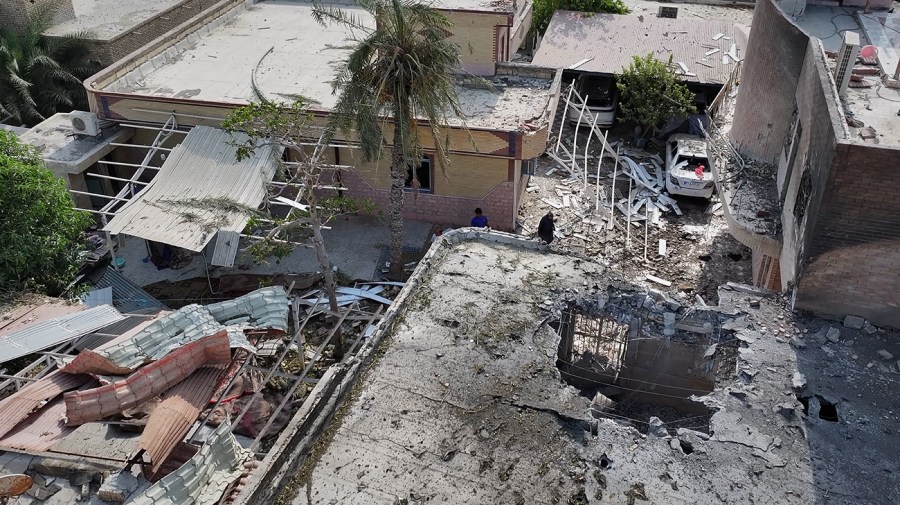
U.S. hits about 100 Iranian targets; Iran fires back at American bases in four countries, and a cruise missile kills 4 at a wedding

Iranian officials count at least 18 dead along the southern coast, four of them at a wedding compound in Kuhestak; Brent crude passed $90 a barrel and no U.S. casualties were reported in the retaliation.

Aug. 30 — The U.S. destroyed two Iranian rocket launchers loaded to mine the Strait of Hormuz, its first acknowledged action inside Iran since July 29. Iran fired eight missiles at bases in Jordan; all were intercepted. Sept. 1 — American forces began hitting IRGC air-defense, radar and mine-laying sites along Iran's southern coast at noon. Trump said a larger attack was "waiting in the wings." Brent crude passed $90 a barrel. Sept. 2 — Iran said its retaliation had begun as U.S. strikes near the strait continued. Transits through Hormuz fell by half, from about 10 ships a day to five.

ContextReopening the Strait of Hormuz was never an original war aim. Trump's stated objective for six months has been preventing an Iranian nuclear weapon. The strait became the condition for ending the fighting only after shipping was disrupted this summer, and what is actually moving through it is the subject of the next story. Oman had a draft arrangement pending as of Aug. 9 involving envoys Steve Witkoff and Jared Kushner. It stalled when Tehran added demands for war compensation, full sanctions relief and release of frozen funds. No Gulf government has said whether its bases were used for the Sept. 1 strikes.

TIME15 sources

U.S. drones hit 2 Iranian tankers under a new "tanker for tanker" policy as the Navy escorts a record 40-ship convoy through Hormuz

Two Filipino sailors were killed on the Saudi tanker Sidr; the escorted convoy carried 18 million barrels, while independent trackers still put average flows at 4.19 million barrels a day against 16.63 million before the war.

The record convoy, and what it does not settle: U.S. forces shot down Iranian drones the same day while escorting what officials called the largest volume of the war: 40 commercial vessels carrying 18 million barrels, per CNN. No U.S. or commercial ship in the convoy was reported hit. Officials did not say how long the convoy took to pass through, so 18 million barrels is not a daily flow figure. (TS: the IEA put 2025 average Hormuz crude and oil-products flow at about 20 million barrels per day.) CENTCOM's June 20 release reported 55 merchant transits and more than 17 million barrels moved, without defining what counted as one convoy.

ContextThe Strait of Hormuz is the 21-mile-wide channel between Iran and Oman that every Gulf oil cargo must pass through, and about a fifth of the world's oil normally moves through it — which is why a halved day of traffic reaches the pump. About 21 million barrels a day crossed it before the war, per Kpler, so the roughly 4 million barrels aboard the two tankers attacked this week equal close to a fifth of a normal prewar day. A June memorandum let escorted commercial traffic resume; recovery has been jagged, improving in early July and falling back after fresh tanker attacks, and the EIA expected shipments to stay severely constrained through August and to recover only slowly in September — a forecast one convoy does not overturn. The IMO has logged 72 confirmed attacks on shipping in the strait since the war began — 21 in the first seven weeks, 46 by June 11 — about one every 2.6 days, killing at least 21 seafarers, including the two Filipino sailors on the Sidr. War-risk insurance for the crossing now runs 7.5% to 10% of a ship's value, roughly $7.5 million on a $100 million tanker, against 0.25% before the war.

BBC NEWS4 sources

Federal judge blocks Trump's Aug. 6 order narrowing birthright citizenship, calling it "almost certainly unconstitutional"

Judge Deborah Boardman's 35-page ruling protects a previously certified nationwide class: children born in the U.S. on or after Feb. 19, 2025 whom the order would exclude, plus their parents.

How the injunction covers people nationwide after the universal-injunction limits: Boardman used Rule 23(b)(2), which lets one injunction cover a certified class when the government treats everyone in it the same way — not a universal injunction shielding strangers to the case. The Supreme Court's restriction on universal injunctions left that class mechanism intact, and it upheld nationwide class relief in Trump v. Barbara. The ruling is preliminary: it freezes enforcement while the case proceeds, and does not finally decide whether the order is constitutional.

ContextBirthright citizenship rests on the Fourteenth Amendment and United States v. Wong Kim Ark (1898), which the government lost 6-2 after arguing a man born in San Francisco to Chinese merchant parents was not a citizen. Every administration since the 1940 and 1952 citizenship statutes recognized the rule, excepting only children of accredited diplomats and hostile occupying forces. That old diplomat exception is why the August order's second target group — children of foreign embassy workers — sits closer to settled law than its first. The Supreme Court struck down Trump's broader January 2025 order 6-3, largely because 8 U.S.C. 1401(a) — the statute that writes the traditional rule into federal law — already covered the question. A ruling on statutory grounds decides less than a constitutional one: it says the order conflicts with a law Congress wrote, without settling what the Fourteenth Amendment itself requires. That left room for the administration to try a narrower order, and it leaves the constitutional question open in this case too. Boardman's answer so far is that the new order is "almost certainly unconstitutional," but that is a preliminary judgment, not a final one.

NBC NEWS6 sources

4not newslongformUpdate

U.S. average diesel price hits $5.69 a gallon, up 54% in a year, as August inventories fall to 1980s seasonal lows

Exports of diesel and related fuels rose about 28% over the past year even as domestic stocks tightened; the price is up 33 cents in the past month alone.

A Pennsylvania school district's budget showed on Aug. 30 how war-driven diesel costs reach local spending. On Sept. 1 U.S. crude passed $90 a barrel, up 12% in a week, and the emergency oil reserve fell to 286.6 million barrels, its lowest since 1982.

ContextDiesel moves nearly every truck, freight train, tractor and delivery van in the US, so its price surfaces later in grocery and shipping bills rather than at the pump. The Federal Reserve's June 2026 Beige Book, a survey of business conditions across the country, recorded roughly 30% jumps in diesel and lubricant costs, higher fuel surcharges and firms expecting to pass costs to consumers. Today's 54% rise is nearly twice that. Federal moving contracts add 1% to freight charges for every 13-cent rise in diesel. EIA's weekly stock series starts in August 1982, and late-August stocks have not been this low since the mid-1980s.

NBC NEWS1 source