Political GuyentistSaturday, August 8, 2026
23 stories·5 news2 not news6 briefs10 elections·0 contested·0 cut
1world

Saudi Arabia, Turkey and Pakistan sign mutual-defense pact

The three states span the eastern Mediterranean, Arabian Peninsula and South Asia; Pakistan is the only one with nuclear weapons.

The three governments say an attack on one will be treated as an attack on all. The pact calls for deeper defense cooperation, joint defense-industry projects and counterterrorism work; a Turkish official described it as defensive and not aimed at any particular country.

ContextWho just linked their defenses? The three countries sit in different regions: Turkey borders the eastern Mediterranean and Black Sea, Saudi Arabia covers most of the Arabian Peninsula, and Pakistan borders India, China, Afghanistan and Iran. World Bank 2024 data put their populations at 85.5 million, 35.3 million and 251.3 million, respectively. Turkey and Saudi Arabia each have economies above $1.2 trillion; Pakistan’s was about $372 billion. Using the CIA World Factbook’s comparable 2022 estimates, preserved by the Internet Archive, Pakistan fielded about 630,000 active-duty personnel, Turkey 445,000 and Saudi Arabia 225,000. SIPRI counts Pakistan among the world’s nine nuclear-armed states, with roughly 170 warheads at the start of 2026. Saudi Arabia and Turkey do not possess sovereign nuclear arsenals. What the pact does—and does not—promise Saudi Arabia and Pakistan signed a bilateral mutual-defense pact in September 2025; the new agreement adds Turkey, which has NATO’s second-largest military by personnel. It says it does not replace existing commitments, including Turkey’s NATO obligations, but gives no public trigger, command structure or troop commitment. Analysts quoted by AP said diplomacy, arms development and technology transfer are more likely near-term effects than mass deployments. The nuclear question is also deliberately unresolved: Pakistan’s arsenal raises the pact’s deterrent value, but the text does not say its nuclear guarantee extends to either partner.

AP6 sources
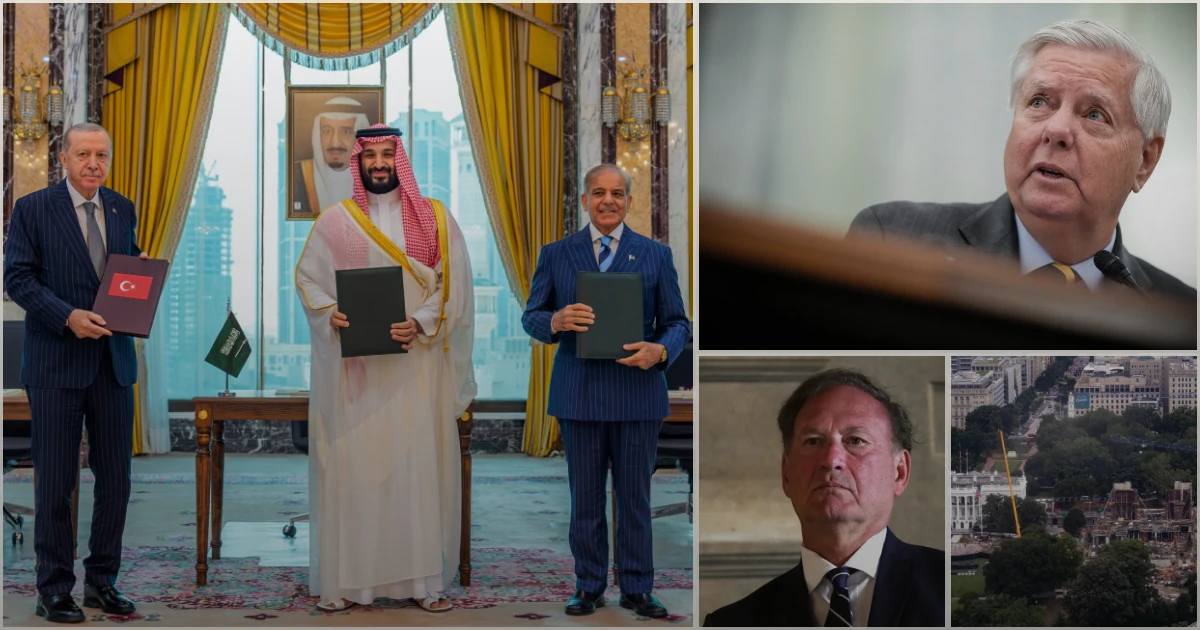
Senate passes Lindsey Graham’s Russia-Iran sanctions bill, 86-11

The bill threatens tariffs of up to 100% against major buyers of Russian energy—but it still needs the House, and enforcement would hinge on waivers and buyer compliance.

The measure targets the five largest importers of Russian oil or gas and the five leading facilitators of sanctions evasion. It also sanctions Russian officials, banks, state companies and shadow-fleet vessels, and extends the Iran Sanctions Act through 2031. The president may waive penalties after certifying that a waiver serves the national interest and reporting it to Congress.

ContextWhy Russia’s energy trade is large enough to matter The U.S. Energy Information Administration says Russia was the world’s second-largest crude exporter in 2023: 4.8 million barrels a day, or 11% of the global total. In 2024, India bought 34% of Russian crude exports and China 26%—60% combined. Russia also exported 4.5 trillion cubic feet of natural gas in 2024 and ranked among the world’s largest gas exporters. Would the sanctions work? Not immediately. Senate passage does not create tariffs: the House must pass the bill, the president must sign it and the administration must decide whom to penalize. Broad presidential waivers could substantially limit enforcement. If Washington actually forced India and China to choose between Russian oil and U.S. market access, Moscow could lose revenue or offer deeper discounts. But removing a supplier responsible for roughly one-tenth of world crude exports could also lift global prices, and Russia has already shown it can reroute oil through intermediaries and a shadow fleet. Natural gas is harder to redirect because pipelines and LNG terminals constrain where it can go.

AP6 sources

Justice Samuel Alito says he will stay for another Supreme Court term

The 76-year-old justice ends near-term retirement speculation, preserving the court’s 6–3 conservative majority without giving Trump a fourth appointment this year.

Justice Samuel Alito, 76, said he is “obviously” staying for the court term that begins in October. The statement follows weeks of speculation triggered by an erroneous NPR retirement story that was quickly retracted.

ContextA retirement before the midterm elections could have given President Trump a fourth Supreme Court appointment and allowed Republicans to replace one of the court’s most reliable conservatives while they control the Senate. Staying preserves the existing 6–3 ideological balance; it does not commit Alito beyond the coming term. Supreme Court justices have life tenure, so the decision and timing are his unless he dies or is removed through impeachment.

AP1 source

Appeals court says Trump needs Congress to build the White House ballroom

The 2–1 ruling blocks aboveground work on the $400 million, 90,000-square-foot project after a 14-day window for a Supreme Court appeal.

A divided D.C. Circuit panel upheld a preliminary injunction against aboveground construction of the $400 million, 90,000-square-foot ballroom on the former East Wing site. The ruling is stayed for 14 days so the administration can seek Supreme Court review; underground bunker, medical and security work may continue.

ContextWhy this is bigger than a building permit The court said a president is a temporary occupant of federal property and cannot use private financing to bypass Congress’s authority over a major White House reconstruction. Congress refused a $1 billion request for the project in May. Trump argues that the privately funded ballroom is inseparable from security upgrades needed against drones, missiles and biological threats. The ruling does not permanently forbid a ballroom. It says the administration must win congressional authorization or prevail in the continuing litigation. Trump has promised an immediate Supreme Court appeal, making the case a test of executive control over the physical White House as well as the fate of the project.

AP1 source

Trump issues narrower birthright-citizenship and “birth tourism” orders

One order denies federal recognition to four categories of future U.S.-born children; the other targets visas and operators tied to travel for childbirth.

The first order tells federal agencies not to recognize citizenship for future U.S.-born children when neither parent is a citizen and a parent is an “alien enemy,” certain foreign-government or international-organization employee, involved in a commercial transaction to obtain birthright citizenship, or the child is born in a territory where federal law does not confer citizenship. A second order directs State and Homeland Security to deny, revoke or restrict visas and target businesses that facilitate travel to give birth.

ContextWhat changed after the Supreme Court loss? Trump’s 2025 order broadly denied automatic citizenship when a mother was undocumented or temporarily present and the father was neither a citizen nor permanent resident. The Supreme Court rejected that approach in June 2026. The new orders use narrower categories and immigration-enforcement powers, but they still assert executive authority over citizenship rules and are likely to face new constitutional and statutory challenges. Existing law already excludes children of accredited foreign diplomats; the new order attempts to extend that logic to much broader classes of foreign employees and designated enemies. How unusual is the U.S. rule among peer countries? Among the G7, only the United States and Canada provide generally automatic citizenship by birthplace. Pew’s 2026 GLOBALCIT analysis classifies Germany as conditional on a parent’s legal residence and France as limited by parentage rules; the United Kingdom also requires a citizen or settled parent. Italy and Japan do not recognize general birthright citizenship. Globally, Pew counted 33 countries with generally automatic birthright citizenship, concentrated in the Americas. The comparison explains why the U.S. is unusual among wealthy democracies; it does not answer whether a president can change a constitutional and statutory rule without Congress.

WHITE HOUSE5 sources

6not newstech

DeepMind warns AI science could hit a validation bottleneck

Its policy paper argues that testing machine-generated ideas—not producing them—may become the limiting step.

DeepMind cites an Imperial College microbiology team that spent most of a decade developing an antibiotic-resistance hypothesis; in 2024, an AI Co-Scientist system returned five hypotheses in two days and ranked the same one first. The paper uses that case to argue for more capacity to fund, test and independently validate machine-generated ideas. The example comes from DeepMind and does not establish that such agents are broadly reliable.

ContextScientific coding and formal mathematics are comparatively easy to validate because a computer can often check whether an answer works. Biology, medicine and materials science still require scarce lab time, physical samples, specialized equipment and experts capable of spotting a single fabricated premise. AI can therefore make proposed experiments abundant faster than institutions can decide which ones deserve money and bench space. DeepMind also describes a Stanford liver-fibrosis case: neither of two drugs selected by a human expert helped in live-cell assays, while two of three candidates selected by Co-Scientist blocked fibrosis and promoted regeneration. That is an intriguing case study, not a benchmark across labs or fields—and it reinforces the point that the AI’s candidates still needed physical validation.

GOOGLE DEEPMIND1 source

White House gives Fed governor Lisa Cook 21 days to answer mortgage-fraud allegations

The new notice follows the Supreme Court’s due-process roadmap; the unresolved issue is what “for cause” means for an institution built to resist day-to-day political pressure.

An Aug. 5 letter signed by White House deputy chief of staff Dan Scavino cites alleged false statements in Cook’s mortgage agreements and gives her until Aug. 26 to respond. The White House says the conduct would constitute cause for removal. Cook’s lawyers call the allegations baseless; she has not been criminally charged.

ContextWhat Cook is accused of The referral alleges Cook identified homes in Michigan and Georgia as her “primary residence” in separate 2021 mortgage documents. Her lawyer says an earlier application called the Georgia condo a vacation home, her federal confirmation filings called it a second home, and the later notation was an isolated error rather than intentional fraud. Why the fight reaches beyond one governor The Federal Reserve Act allows a president to remove a governor “for cause,” but no president had purported to fire a Fed governor in the central bank’s 111-year history before Trump’s first attempt. Cook’s term runs through January 2038. Fed governors serve staggered 14-year terms specifically to insulate monetary policy from daily political pressure. If the courts accept the administration’s definition of cause, the decision would shape how much control future presidents can exert over the board that helps set interest rates. The Supreme Court’s June decision let Cook remain while the litigation continues and said the first firing lacked adequate notice and a chance to respond. It did not decide whether the mortgage allegations meet the legal standard. The Aug. 26 response will build the record for that next fight. What traders are pricing [Kalshi’s exact-contract series](https://kalshi.com/markets/kxtryfirecook/) asks whether the president will try to fire Cook by four different deadlines. At 8:32 a.m. CT on Aug. 8, the implied chances were 6.5% by Aug. 14, 39.5% by Sept. 1, 67.5% by Oct. 1 and 86% by Jan. 1. That is a time curve—not four independent forecasts—and it does not measure whether a firing would survive in court or whether Cook would actually leave the board.

AP5 sources

Saturday · The daily brief

Aug 82026

7 leads16 briefs16 min

Listen

AI narration

The whole issue in a few minutes · 2:41 at 1×

Transcript

Executive summary7 stories

News news5

  1. Saudi Arabia, Turkey and Pakistan sign mutual-defense pactThe three states span the eastern Mediterranean, Arabian Peninsula and South Asia; Pakistan is the only one with nuclear weapons.
  2. Senate passes Lindsey Graham’s Russia-Iran sanctions bill, 86-11The bill threatens tariffs of up to 100% against major buyers of Russian energy—but it still needs the House, and enforcement would hinge on waivers and buyer compliance.
  3. Justice Samuel Alito says he will stay for another Supreme Court termThe 76-year-old justice ends near-term retirement speculation, preserving the court’s 6–3 conservative majority without giving Trump a fourth appointment this year.
  4. Appeals court says Trump needs Congress to build the White House ballroomThe 2–1 ruling blocks aboveground work on the $400 million, 90,000-square-foot project after a 14-day window for a Supreme Court appeal.
  5. Trump issues narrower birthright-citizenship and “birth tourism” ordersOne order denies federal recognition to four categories of future U.S.-born children; the other targets visas and operators tied to travel for childbirth.

Not news news2

  1. DeepMind warns AI science could hit a validation bottleneckIts policy paper argues that testing machine-generated ideas—not producing them—may become the limiting step.
  2. White House gives Fed governor Lisa Cook 21 days to answer mortgage-fraud allegationsThe new notice follows the Supreme Court’s due-process roadmap; the unresolved issue is what “for cause” means for an institution built to resist day-to-day political pressure.

News news5 stories

1.) AP: Saudi Arabia, Turkey and Pakistan sign mutual-defense pact

The three states span the eastern Mediterranean, Arabian Peninsula and South Asia; Pakistan is the only one with nuclear weapons.

What the pact does—and does not—promise

Saudi Arabia and Pakistan signed a bilateral mutual-defense pact in September 2025; the new agreement adds Turkey, which has NATO’s second-largest military by personnel. It says it does not replace existing commitments, including Turkey’s NATO obligations, but gives no public trigger, command structure or troop commitment. Analysts quoted by AP said diplomacy, arms development and technology transfer are more likely near-term effects than mass deployments. The nuclear question is also deliberately unresolved: Pakistan’s arsenal raises the pact’s deterrent value, but the text does not say its nuclear guarantee extends to either partner.

2.) AP: Senate passes Lindsey Graham’s Russia-Iran sanctions bill, 86-11

The bill threatens tariffs of up to 100% against major buyers of Russian energy—but it still needs the House, and enforcement would hinge on waivers and buyer compliance.
Currently showing Russia's oil-export exposure
Russia's oil-export exposure
The bill’s leverage runs through Russia’s biggest oil buyers Crude oil and condensate exports; destination shares are 2024 estimates 11% of global crude exports · 2023 came from Russia in 2023 4.8 million barrels per day Who bought Russia’s crude · 2024 India 34% China 26% Others 40% What that means India and China together bought 60% of Russian crude exports. Secondary tariffs could pressure that trade—but only after House passage, presidential action and buyer compliance. Source: U.S. Energy Information Administration, Russia country analysis (updated Dec. 2025).

Would the sanctions work?

Not immediately. Senate passage does not create tariffs: the House must pass the bill, the president must sign it and the administration must decide whom to penalize. Broad presidential waivers could substantially limit enforcement. If Washington actually forced India and China to choose between Russian oil and U.S. market access, Moscow could lose revenue or offer deeper discounts. But removing a supplier responsible for roughly one-tenth of world crude exports could also lift global prices, and Russia has already shown it can reroute oil through intermediaries and a shadow fleet. Natural gas is harder to redirect because pipelines and LNG terminals constrain where it can go.

3.) AP: Justice Samuel Alito says he will stay for another Supreme Court term

Justice Samuel Alito, 76, said he is “obviously” staying for the court term that begins in October. The statement follows weeks of speculation triggered by an erroneous NPR retirement story that was quickly retracted.

Ongoing1 earlier update

This story has run 2 times over 12 days, starting Jul 27.

  1. Trump asks Supreme Court to revive federal voter list and mail-ballot limits
  2. Appeals court says Trump needs Congress to build the White House ballroom — this issue

4.) AP: Appeals court says Trump needs Congress to build the White House ballroom

5.) WHITE HOUSE: Trump issues narrower birthright-citizenship and “birth tourism” orders

Currently showing How the G7 handles citizenship by birthplace
How the G7 handles citizenship by birthplace
The U.S. is one of two G7 countries with broad birthright citizenship Rule for a child born on the territory · national exceptions and edge cases omitted BROADLY AUTOMATIC 2 OF 7 G7 COUNTRIES US United States CA Canada Citizenship generally follows birthplace PARENT OR RESIDENCE CONDITIONS 3 OF 7 G7 COUNTRIES DE Germany A parent must meet legal-residence rules FR France Parentage and residence limits apply UK United Kingdom A parent must be a citizen or settled NO GENERAL TERRITORIAL RULE 2 OF 7 G7 COUNTRIES IT Italy JP Japan Worldwide, 33 countries generally grant citizenship by birthplace They are concentrated in the Americas. The G7 comparison does not decide what U.S. law permits a president to change. Source: Pew Research Center / GLOBALCIT, 2026. Simplified categories; national law contains exceptions.

The comparison explains why the U.S. is unusual among wealthy democracies; it does not answer whether a president can change a constitutional and statutory rule without Congress.

Quick bites16

  1. The Strategic Petroleum Reserve has no single countdown

    How unusual is this release?

    The 2022 release of 180 million barrels was the SPR’s largest drawdown, making the current planned 172-million-barrel release nearly as large. Since 1985, DOE has released more than 500 million barrels from the reserve, with nearly 70% of all releases occurring from 2014 through 2025.

    Will the barrels come back?

    DOE structured the 2026 action as an exchange rather than a permanent sale: companies receive crude now and owe barrels back later, generally with an additional premium. That makes the refill schedule part of the policy. A promised return is not the same as oil already underground, and GAO says deferred maintenance and cavern problems can constrain how much usable oil the government can deliver even when the inventory number looks adequate.

    Ongoing1

    This story has run 2 times over 10 days, starting Jul 29.

    1. DOE isn’t systematically using foreign nuclear-cleanup lessons
    2. The Strategic Petroleum Reserve has no single countdown — this issue
  2. ICE controls body-camera releases

    ICE says field officers nationwide will have body cameras by the end of September. Its policy, however, says footage will be released only when doing so is in the agency’s “best interests.”

    Who decides what the public sees?

    A committee of senior ICE officials and lawyers reviews footage of incidents involving death or serious injury and recommends whether to release it. If the agency decides release serves its interests, it generally aims to finish the review within 72 hours. The ICE director may block or indefinitely delay publication under unspecified “specific and compelling circumstances,” and any released video must obscure officers’ faces and other identifying information.

    That distinction is the accountability issue: cameras can preserve evidence for investigators and lawsuits even when footage is not public, but the policy does not create an automatic public-release rule or an independent decision-maker. The people being recorded cannot themselves trigger publication.

  3. Pentagon revokes Kendall’s clearance

    The Pentagon revoked former Air Force Secretary Frank Kendall’s eligibility to access classified information and barred him from sensitive positions, accusing him of an unauthorized disclosure about Air Force One. Kendall said he was “completely mystified” and had not been told what information the government considered classified.

    The dispute follows reporting that the Qatari-donated replacement aircraft lacked some advanced defensive systems. Kendall had said the accelerated conversion left too little time for “all the normal Air Force One modifications” and that he was surprised the plane was used outside the United States. The Pentagon has not identified the allegedly classified statement or the outlet involved, and it did not say whether it referred Kendall for prosecution.

    The immediate penalty is administrative, not a criminal conviction: it removes Kendall’s eligibility for future classified work or sensitive government and contractor roles. Unless the Pentagon identifies the classified statement, names the outlet or discloses a criminal referral, the clearance revocation will remain the government’s only public action against Kendall.

  4. Senate confirms Todd Blanche as attorney general, 50–49

    The Senate confirmed President Trump’s former personal lawyer in an overnight vote. Republicans Susan Collins and Lisa Murkowski joined Democrats in opposition; Bill Cassidy supplied the decisive support after saying Blanche was better positioned than another nominee to push back on Trump when necessary.

    Blanche had already run the Justice Department in an acting capacity since Pam Bondi’s April departure. His nomination nearly failed over a proposed $1.8 billion compensation fund for Trump allies and a settlement provision shielding Trump and his family from IRS audits. Blanche promised in writing to abandon the fund and narrow the tax protection, unlocking support from Republican holdouts.

    Kalshi carried a confirmation market while the vote was unresolved, but the 50–49 result now outranks—and settles—the forecast. The first concrete test is whether Blanche keeps the two written commitments that secured confirmation: abandoning the compensation fund and narrowing the tax protection. The vote did not resolve how he will handle investigations involving Trump’s opponents.

    Ongoing1

    This story has run 2 times over 4 days, starting Aug 4.

    1. Blanche scraps a $1.8 billion political-targeting claims fund and wins two GOP confirmation votes
    2. Senate confirms Todd Blanche as attorney general, 50–49 — this issue
2 more quick bitesSame day, same run — headlines only until you open one
  1. Homeowners sue over New York City’s pied-à-terre tax rollout

    Three homeowners sued Mayor Zohran Mamdani and the city finance commissioner, challenging a supplemental tax roll that listed more than 900,000 properties and notices sent to some residents. The complaint does not seek to strike down the underlying surcharge.

    The annual surcharge applies only to qualifying non-primary residences. For 2026–27 and 2027–28, one- to three-family homes enter at a city market value of $5 million, with rates from 0.8% to 1.3%; condos and co-ops enter at $1 million, with rates from 4% to 6.5% under the city’s separate valuation rules. Primary residences used by an owner, tenant or immediate family member are exempt.

    The Department of Finance says only about 17,000 owners received “may be subject” letters and that appearing on the much larger public roll does not mean a bill is due. The lawsuit argues that the rollout wrongly put the burden on residents to prove exemptions and unnecessarily exposed names and addresses. The city extended the exemption deadline to Sept. 18; any surcharge due appears on the Jan. 1, 2027 property-tax bill.

  2. Judge orders Pentagon to resume onshore-wind reviews

    A federal judge ordered the Defense Department to restart national-security reviews for onshore wind projects after the process slowed beginning in August 2025 and stopped entirely in April.

    The Pentagon reviews proposed turbines during the Federal Aviation Administration process because tall structures can interfere with military radar, training routes and other operations. Developers and the military normally negotiate mitigation rather than treat every conflict as a veto. The industry plaintiffs said the freeze stalled at least 106 verified projects across 21 states—about 29 gigawatts of proposed capacity and $47 billion in investment.

    The order does not approve those wind farms. It requires the Pentagon to resume the case-by-case process so projects can receive conditions, rejection or clearance on the record. Wind currently supplies about 10% of U.S. electricity, so a nationwide review stoppage affects far more capacity than a single permit dispute.

Elections10 races

Congressional control

Who ends up holding each chamber

Aug 8, 8:35 AM CT
7-day replay

U.S. House: chance of Democratic control of the House, Polymarket 88%, Kalshi 85%. U.S. Senate: chance Democrats take it, Polymarket 46%, Kalshi 47%. Full day-by-day figures are in the table below.

U.S. HouseDemocratic control7 days ago · Democrats favoured
86%84%chance of Democratic control of the House · 1.5pp apart
U.S. House: chance of Democratic control of the House. 7 days ago, Polymarket 86% and Kalshi 84%. Today it stands at Polymarket 88% and Kalshi 85%.
U.S. SenateDemocrats take it7 days ago · Republicans favoured
45%46%chance Democrats take it · 1.5pp apart
U.S. Senate: chance Democrats take it. 7 days ago, Polymarket 45% and Kalshi 46%. Today it stands at Polymarket 46% and Kalshi 47%.
7 days ago
How to read thisthe contract, the key, and the week panel

Each bar is one contract: will Democrats control this chamber after the 2026 midterms. The Republican share is the arithmetic complement of that price, not a separately traded market. Republicans hold the Senate, so the figure printed there is the chance Democrats take it. This desk has not established who is defending the House, so that bar stays in the market’s own words and claims nothing about who would be losing it. Two venues price each contract; where they differ the lighter wedge is how far apart they are, and the panel on the right is the week.

  • two venues, priced separately
  • shaded = how far apart they are
  • 50% — control flips here
  • the last 7 days, on its own scale
  • Polymarket, solid
  • Kalshi, dashed

Both lines in a week panel are the same contract, priced by two venues — not one line per party. Its colour is whose chance the bar is measuring, which is why a panel can be blue while the verdict beside it reads Republicans favoured.

3 of 10 races. Open one, or all of them — every race is on the page either way.

  • jAlaska Senate generalAlaska Senateone bookMary Peltola 52.5%Dan Sullivan 48.5%

    ALASKA DIVISION OF ELECTIONS: Alaska Senate — primary still ahead

    Former Democratic Rep. Mary Peltola and Republican Sen. Dan Sullivan are the nationally watched candidates, but they have not yet secured November ballot spots. Alaska’s 16-candidate, nonpartisan primary is Aug. 18; the top four advance to a ranked-choice general election. The odds below price the eventual November winner, not merely who finishes first in the primary.

    The top-four primary is Aug. 18; the displayed markets price the eventual November winner

  • kIowa Senate generalIowa SenateAshley Hinson 58.0%Josh Turek 43.0%

    POLYMARKET: Iowa Senate — general election

    Republican Ashley Hinson faces Democrat Josh Turek for an open seat. The individual-race market is distinct from the national Senate-control contracts shown at the top of this section.

    An open-seat contest

    Two markets, one question

    Iowa Senate general

    Aug 8, 8:35 AM CT
    widest venue gap 3.0pp
    • Polymarket, solid
    • Kalshi, dashed
    • shaded = the gap between them

    Iowa Senate general. Ashley Hinson (R): Polymarket 56.5%, Kalshi 59.5%; Josh Turek (D): Polymarket 44.5%, Kalshi 41.5%. Widest disagreement between the two venues: 3.0pp. Full history is in the table below.

    7 days ago

    Market-implied chance of winning, out of 100 — prices, not polls. Source: Polymarket · Kalshi.

  • hMaine Senate generalMaine Senateone bookTroy Jackson 68.5%Susan Collins 32.5%

    AP: Maine Senate — general election

    Democrat Troy Jackson faces Republican Sen. Susan Collins. Maine is central to Democrats’ attempt to erase the GOP’s Senate majority.

    A top Democratic pickup opportunity

The other 7 races10 consequential races · Aug 8, 8:35 AM CT · markets, not polling

Senate3 of 6

  • lMichigan Senate generalMichigan Senateone bookAbdul El-Sayed 60.5%Mike Rogers 40.5%

    AP: Michigan Senate — general election

    Democrat Abdul El-Sayed faces Republican Mike Rogers. AP called the Aug. 4 Democratic primary for El-Sayed after he led Haley Stevens by just under one percentage point; this is now a general-election forecast, not a primary market.

    El-Sayed won the Democratic primary by less than one point

  • mOhio Senate generalOhio SenateSherrod Brown 51.0%Jon Husted 49.5%

    POLYMARKET: Ohio Senate — general election

    Democrat Sherrod Brown faces Republican Sen. Jon Husted. Ohio has leaned Republican in recent statewide elections, but Brown previously won three Senate terms there.

    A special election for a Republican-held seat

    Two markets, one question

    Ohio Senate general

    Aug 8, 8:35 AM CT
    widest venue gap 1.0pp
    • Polymarket, solid
    • Kalshi, dashed
    • shaded = the gap between them

    Ohio Senate general. Sherrod Brown (D): Polymarket 51.5%, Kalshi 50.5%; Jon Husted (R): Polymarket 49.5%, Kalshi 49.5%. Widest disagreement between the two venues: 1.0pp. Full history is in the table below.

    7 days ago

    Market-implied chance of winning, out of 100 — prices, not polls. Source: Polymarket · Kalshi.

  • iTexas Senate generalTexas SenateKen Paxton 50.8%James Talarico 49.0%

    POLYMARKET: Texas Senate — general election

    Republican Ken Paxton faces Democrat James Talarico. The market measures the exact November winner, not either party’s national Senate total.

    A Republican-held seat Democrats hope to make competitive

    Two markets, one question

    Texas Senate general

    Aug 8, 8:35 AM CT
    widest venue gap 1.0pp
    • Polymarket, solid
    • Kalshi, dashed
    • shaded = the gap between them

    Texas Senate general. Ken Paxton (R): Polymarket 51.0%, Kalshi 50.5%; James Talarico (D): Polymarket 49.5%, Kalshi 48.5%. Widest disagreement between the two venues: 1.0pp. Full history is in the table below.

    7 days ago

    Market-implied chance of winning, out of 100 — prices, not polls. Source: Polymarket · Kalshi.

Governors4

  • oGeorgia governor generalGeorgia governorone bookKeisha Lance Bottoms 59.5%Rick Jackson 40.5%

    AP: Georgia governor — general election

    Democrat Keisha Lance Bottoms faces Republican Rick Jackson. Jackson won the Republican runoff after spending more than $93 million of his own money; Bottoms won the Democratic primary outright.

    An open-seat contest in a closely divided state

  • pNevada governor generalNevada governorAaron Ford 53.0%Joe Lombardo 46.3%

    POLYMARKET: Nevada governor — general election

    Democrat Aaron Ford faces Republican Gov. Joe Lombardo. Market prices are a real-money snapshot of this exact contest, not a substitute for polling or a guarantee of the result.

    A Democratic challenger against a Republican incumbent

    Two markets, one question

    Nevada governor general

    Aug 8, 8:35 AM CT
    widest venue gap 3.5pp
    • Polymarket, solid
    • Kalshi, dashed
    • shaded = the gap between them

    Nevada governor general. Aaron Ford (D): Polymarket 52%, Kalshi 54%; Joe Lombardo (R): Polymarket 48.0%, Kalshi 44.5%. Widest disagreement between the two venues: 3.5pp. Full history is in the table below.

    7 days ago

    Market-implied chance of winning, out of 100 — prices, not polls. Source: Polymarket · Kalshi.

  • gOhio governor generalOhio governorVivek Ramaswamy 53.0%Amy Acton 47.3%

    POLYMARKET: Ohio governor — general election

    Republican Vivek Ramaswamy faces Democrat Amy Acton. Market prices below are snapshots, not polls; they can move with news, liquidity and trader composition.

    Open-seat general election

    Two markets, one question

    Ohio governor general

    Aug 8, 8:35 AM CT
    widest venue gap 5.0pp
    • Polymarket, solid
    • Kalshi, dashed
    • shaded = the gap between them

    Ohio governor general. Vivek Ramaswamy (R): Polymarket 55.5%, Kalshi 50.5%; Amy Acton (D): Polymarket 45.0%, Kalshi 49.5%. Widest disagreement between the two venues: 5.0pp. Full history is in the table below.

    7 days ago

    Market-implied chance of winning, out of 100 — prices, not polls. Source: Polymarket · Kalshi.

  • nWisconsin governor Democratic primaryWisconsin governorone bookFrancesca Hong 95.3%Crowley 4.9%

    AP: Wisconsin governor — nominees not yet settled

    Wisconsin votes Tuesday, Aug. 11. Democratic socialist Francesca Hong faces Milwaukee County Executive David Crowley and other Democrats; Republican Tom Tiffany faces nominal opposition. At 8:35 a.m. CT on Aug. 8, Polymarket priced Hong at 95.3% and Crowley at 4.9% to win the Democratic nomination. The rows below show that Democratic-primary market only; they do not price the Republican primary or the November general election.

    Hong leads the Democratic field; Tiffany faces nominal Republican opposition

    Two markets, one question

    Wisconsin governor Democratic primary

    Aug 8, 8:35 AM CT
    one venue only
    • Polymarket, solid

    Wisconsin governor Democratic primary. Francesca Hong (D): Polymarket 95.3%; David Crowley (D): Polymarket 4.9%. Full history is in the table below.

    7 days ago

    Market-implied chance of winning, out of 100 — prices, not polls. Source: Polymarket.

Prices captured Aug 8, 8:35 AM CT. These are trader-implied estimates, not polls. Separate contracts trade independently, so opposing prices may not add to exactly 100%.

Not news news2 stories

6.) GOOGLE DEEPMIND: DeepMind warns AI science could hit a validation bottleneck

Its policy paper argues that testing machine-generated ideas—not producing them—may become the limiting step.
Currently showing DeepMind's Stanford validation case study
DeepMind's Stanford validation case study
How five shortlisted candidates fared in one reported screen Pass/fail outcomes only; DeepMind’s policy paper did not publish effect measurements HUMAN EXPERT 2 candidates tested NO HIT NO HIT 0 live-cell hits AI CO-SCIENTIST 3 candidates tested HIT HIT NO HIT 2 live-cell hits CASE STUDY, NOT BENCHMARK The sample is too small to estimate a general AI success rate, and the paper did not report effect sizes. Every AI-selected candidate still required physical testing. Source: Google DeepMind, “Conjecture Machines” (July 2026), describing Gary Peltz’s Stanford study.

7.) AP: White House gives Fed governor Lisa Cook 21 days to answer mortgage-fraud allegations

The new notice follows the Supreme Court’s due-process roadmap; the unresolved issue is what “for cause” means for an institution built to resist day-to-day political pressure.