38 stories·6 news7 briefs25 elections·4 contested·15 cut
Full issue

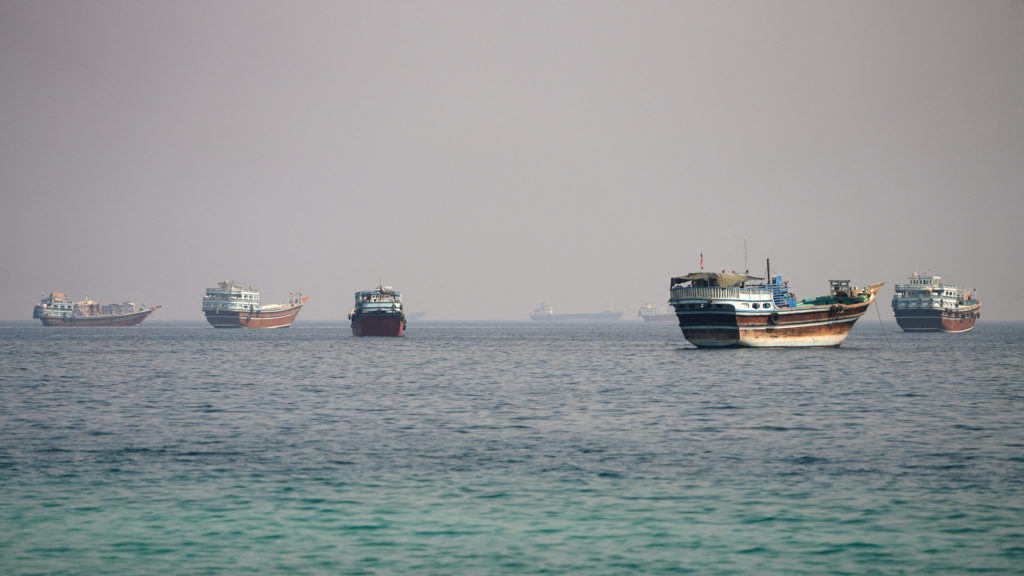
[UPDATE] U.S. bombs two Iranian rocket sites near the Strait of Hormuz; Iran fires eight missiles at Jordan

The strike on Larak Island killed two, ended a month without acknowledged attacks, and pushed Brent crude above $90 a barrel.

The last U.S. strike on Iran's mine-laying crews near the strait was July 29, after which Trump switched to sanctions.

ContextCongress is not in this loop by law. The War Powers Resolution asks only for a report within 48 hours after U.S. forces enter hostilities, and Trump used that process after the renewed July strikes; the White House has promised no advance notice this time. The pace is set by how fast Iran rebuilds: CENTCOM says the earlier campaign destroyed 82% of Iran's air-defense missile systems, and the July 29 strike bought about 33 days before officials reported the radar and anti-ship work restarting. The strait itself has not recovered. Roughly 3.6 million barrels a day moved through it in August, against about 20 million before the February fighting.

PBS NEWSHOUR4 sources

2uscontested

[UPDATE] Pentagon takes a 35% stake in the venture given exclusive rights to 17 Venezuelan oil fields

Officials reach 55% by adding the Pentagon's 35% equity stake to a separate State Department right to buy a fifth of the oil at cost. The equity stake itself is a minority one.

What the announced structure leaves off paper: The 55% is not an ownership share. It adds the Office of Strategic Capital's 35% of the venture's parent to the State Department's separate right to buy 20% of output at production cost. The disclosed terms give the Pentagon a minority equity interest. The Pentagon's Office of Strategic Capital (the unit that finances companies it treats as strategic) says its support can also take the form of a loan or a loan guarantee. The claim that the deal costs nothing does not rule out taxpayer exposure later. No signed agreement or warrant terms have been published. Reporting describes penny warrants — the right to buy shares later for almost nothing — which require almost no cash up front and would conceal any other consideration. Venezuela's 2026 hydrocarbons reform (its rewritten oil law) requires pre-existing production-sharing contracts, which split output between a company and the state, to be adjusted within 180 days, and it bars worsening their agreed terms. That hands displaced operators a claim to bring. China's 2024 investment treaty with Venezuela covers investments already in place and lets investors take expropriation claims — arguments that a state seized their property — to arbitration against Venezuela. The White House promises dividends "for the United States" but names no receiving account. Treasury's published default sends proceeds from a federal security sale to the agency that owns it; whether that default governs this deal cannot be known until the executed agreement or Treasury's own accounting records appear. The venture already pumps roughly 200,000 barrels a day in Venezuela, so the announced target above 1.5 million barrels a day is not all new production.

ContextThe closest thing the Pentagon has done before was at home. In July 2025 it paid $400 million for stock and warrants worth roughly 15% of MP Materials, a California rare-earth miner, to build U.S. processing; the mineral stakes it took after that were domestic too. The $100 billion rebuild equals about 11% of the $896.88 billion the U.S. spent on national defense in fiscal 2025 ($873.89 billion real, 2024 CPI base 313.69), the last full year on record. Source: BEA via FRED (A997RC1A027NBEA), inflation-adjusted with CPIAUCNS to 2024.

PBS NEWSHOUR4 sources

3uscontested2026 midterms

House votes Sept. 1 on a stopgap that funds the government to Dec. 11, pushing the shutdown deadline past the midterms

The Senate already passed it; House leaders want it done in a day, moving the next funding cliff five weeks past the Nov. 3 election.

What the Senate loaded onto the stopgap beyond flat funding: Extends federal highway programs and Highway Trust Fund authority — the money that pays for road and bridge projects — to Dec. 11 alongside the funding itself Blocks a proposed White House budget-office rule that would give political appointees more say over which federal grants get approved Delays by 30 days a national ban on most intoxicating hemp products that was set to take effect

ContextCurrent funding runs out Sept. 30, the end of the federal fiscal year; without a new bill the government starts shutting down the next day. This measure moves that cliff to Dec. 11 — about ten weeks, and 38 days after the Nov. 3 election. Until then agencies generally spend at last year's rates, and all 12 regular spending bills for the new year are still unsettled. Carrying a funding deadline across an election is ordinary: it has happened in 19 of the 25 completed election cycles since 1976, and only twice did the new deadline end in a shutdown lasting a full day.

BLOOMBERG5 sources

Trade talks with Canada collapse, leaving 50% U.S. tariffs on $27.6 billion of Canadian goods

Each side says the other blew up the deal, and the U.S. trade representative answers to House Republicans this week as the tariffs turn into a campaign problem.

The two sides had been negotiating since Trump's 50% tariffs took effect Aug. 22, with Canada's matching tariffs due to land Sept. 8.

ContextThe U.S. duties took effect Aug. 22, 2026, three days after the first planned start, under a 1930 law that lets presidents punish discrimination against U.S. trade. The government’s $27.6 billion figure and the Chicago Fed’s annualized estimate of nearly $24 billion use different measures and currencies, leaving the Fed estimate at least $3.6 billion lower. The $27.6 billion list is $15 billion larger than the $12.6 billion covered during the 353-day steel and aluminum fight that began in 2018. In 2024, two-way trade totaled $762.10 billion; industrial supplies and energy made up 51.6% of U.S. imports from Canada, versus 13.9% for vehicles and parts and 13.8% for other capital goods.

THE HILL3 sources

5us

FTC and 22 states sue Amazon, saying a hidden auction rule overcharged advertisers $20 billion

The suit, filed Monday, Aug. 31, says more than 1 million brands and sellers paid close to their own maximum bid in nearly 80% of the ad auctions they won.

What Amazon's rebuttal numbers do and do not answer: Amazon says that in roughly 92% of ad placements, a lower bidder won. That speaks to who wins an auction, not what the winner is charged. Amazon says that choosing ads by relevance, rather than by bid alone, saved advertisers an estimated $8 billion from 2021 through 2025. That is Amazon's own estimate of a discount, not a test of the alleged surcharge. Amazon has not published the underlying auctions, the bid distributions or the method behind any of those figures. The FTC's claim is narrower: the same winner would have paid one cent above the genuine runner-up. Average bids can fall while individual winners still pay above that line.

ContextAmazon's Sponsored Products ads let sellers buy placement on its own search page. An Institute for Local Self-Reliance analysis of Amazon filings put all seller advertising fees near 7% of sales in 2023, on top of the 15% referral cut. Three comparable U.S. cases came before this one, all against Google: the 2020 search-ads suit, Texas's 2020 "Project Bernanke" case, and the 2023 ad-tech case. None returned an overcharge dollar to an advertiser. Amazon's separate Prime settlement, in September 2025, ran $1 billion in penalties and $1.5 billion in refunds.

THE WASHINGTON POST6 sources

6uscontested

Nine more drugmakers sign Trump Medicaid pricing deals, bringing total to 26

The nine midsize firms pledged $19.6 billion in U.S. manufacturing; no drug, price or savings figure has been released.

What the deals do not say: Which medicines are covered, and at what price — the White House lists only disease categories, not drugs. How much of the $19.6 billion is new: CSL's pledge rests on a $1.5 billion expansion it has been building toward since 2018, and Kyowa Kirin's North Carolina plant broke ground in August 2024. What "90% of the market" measures — revenue, prescriptions, units or covered drugs. No denominator has been published.

ContextMedicaid already gets a discount written into law. For a brand drug the maker must rebate the greater of 23.1% of the average manufacturer price, or the gap between that price and the lowest price it charges any other buyer — plus an extra rebate whenever its price has risen faster than inflation. CMS describes the new most-favored-nation price as a supplemental rebate stacked on top of those, not a replacement for them. Where the statutory rebate already lands at or below the new benchmark, the old discount still controls and the deal adds nothing. None of the drug-level prices that would show which case applies has been published.

NBC NEWS3 sources