Political GuyentistTuesday, August 4, 2026
31 stories·6 news3 not news12 briefs10 elections·0 contested·0 cut
1us

Blanche scraps a $1.8 billion political-targeting claims fund and wins two GOP confirmation votes

The still-unopened fund came from Trump's IRS settlement and would have let a DOJ commission pay people alleging political targeting.

Todd Blanche rescinded DOJ's proposed $1.776 billion Anti-Weaponization Fund after John Cornyn (Sen-R Texas) and Thom Tillis (Sen-R North Carolina) refused to advance his attorney general nomination without a written order ending it. Both senators then backed him. The program had no commissioners, rules or applicants. If it had opened, an attorney-general-appointed commission could have issued apologies or payments to people who said federal officials targeted them for political, personal or ideological reasons.

ContextDOJ [created it in May](https://www.justice.gov/opa/pr/justice-department-announces-anti-weaponization-fund) as part of a settlement in *Trump v. IRS*. Donald Trump, his sons and the Trump Organization agreed to dismiss a lawsuit over the leak of their tax returns, and withdraw administrative claims tied to the Mar-a-Lago search and the Russia investigation, in exchange for a formal apology and the fund's creation. Trump and the other plaintiffs received no direct monetary damages under the settlement. A five-member commission appointed by the attorney general would have decided who qualified for an apology or payment. The money was to come from the Treasury's Judgment Fund, a permanent appropriation used to pay settlements, rather than a new $1.776 billion line item voted on by Congress. That made the dispute larger than a nomination fight: it tested whether an executive-branch settlement could create a broad compensation system for politically charged claims without a fresh appropriation. DOJ cited the $760 million Keepseagle farm-discrimination settlement as precedent; this proposed fund was more than twice as large.

AP30 sources
Israel raises ‘serious security concerns’ over Hamas disarmament deal

The roadmap would move a stalled October ceasefire into its disarmament-and-withdrawal phase.

Trump's Board of Peace, a multinational body established to oversee Gaza's ceasefire and postwar transition, said it negotiated the roadmap with Hamas. The October ceasefire ended major combat and secured the hostages' return, but its next phase stalled as Israeli strikes continued and the sides disputed whether disarmament or further withdrawal should come first. The new roadmap gives a board-created verification committee responsibility for certifying each step. Hamas accepted the announced terms; Israel was not a signatory and has not accepted them. Netanyahu's office warned that withdrawing before Hamas is fully disarmed could let the group rebuild its military infrastructure.

ContextThe roadmap's 14-day clock for drafting an implementation timetable begins only after all parties approve it, and Israel has not accepted the terms. The verification committee may also extend that deadline. Disarmament would not mean transferring Hamas weapons to Israel. Police weapons would pass to Gaza's new technocratic administration, while heavy weapons, production sites, depots and tunnels would be gradually decommissioned or stored under its authority alongside phased Israeli withdrawals. An international force would monitor the ceasefire and support the transition but would not police Palestinians.

NBC NEWS3 sources

Iran denies Trump’s claim that new U.S. talks would start Monday

Trump said negotiations would begin Monday afternoon after he held off on threatened strikes; Iran’s Foreign Ministry said no talks or delegation were scheduled.

President Donald Trump said negotiations to wind down the five-month-old war would begin Monday afternoon after he held off on another wave of strikes. Iran's Foreign Ministry said Monday morning that Tehran was not negotiating with the United States and did not plan to receive or send a delegation in the coming days. No meeting had been independently confirmed by early Monday afternoon.

ContextTrump has threatened major escalation and then held back at least three times during the war. In April, Washington and Tehran announced a ceasefire shortly before his deadline for attacks on infrastructure; in May, he suspended a planned strike while citing 'serious negotiations'; and in June, he canceled threatened attacks on Iran's energy base after claiming peace talks had progressed. The latest pause also followed warnings from Gulf allies about economic repercussions, while recent AP-NORC polling found about two-thirds of U.S. adults said the war had not been worthwhile.

AP2 sources

4world

Zelensky says Russia launched nearly 1,900 drones at Ukraine in one week

President Volodymyr Zelensky said 16 regions were attacked and more than 1,500 sites were damaged during the week.

Zelensky said Russia launched roughly 1,900 attack drones, nearly 1,600 guided aerial bombs and 144 missiles during the week. One week earlier, he reported nearly 1,700 drones, more than 1,630 guided bombs and 95 missiles. The two attributed tallies put drones about 12% higher and missiles about 52% higher week over week, while the bomb count was roughly flat. POLI did not find an independent weekly tally in the cited sources.

ContextThe increase in missiles coincides with pressure on Ukraine's ballistic-missile defenses. Zelensky said Ukrainian forces intercepted only one of 27 ballistic missiles during an Aug. 1 attack on Kyiv because of an interceptor shortage; that attack killed nine people and injured more than 30. The Kyiv Independent reports that Patriot interceptors remain Ukraine's only effective defense against Russia's high-speed Zircon and Iskander missiles.

VOLODYMYR ZELENSKY4 sources

5world

Spain updates Ceuta death toll as it installs sea barrier

Spanish authorities raised the count from 67 deaths Saturday to 72 deaths Sunday as searches continued.

Out of roughly 60,000 arrivals from Morocco on July 30 and 31, Spanish authorities had confirmed 72 deaths by Sunday, including people who drowned or were killed in a stampede. The earlier AP report's 67-death count preceded that update. Spain also installed a 500-meter floating barrier, equivalent to about one-third of a mile, along Ceuta's sea border to reinforce the route around the breakwaters.

ContextThe pneumatic barrier is designed to rise 30 to 70 centimeters above the water and extend as much as one meter below it. A channel between it and anchored naval buoys will let Civil Guard vessels patrol the route. Madrid says people who entered Ceuta irregularly cannot continue to mainland Spain or elsewhere in the Schengen zone; travelers leaving the enclave by air or sea undergo identity checks. [France 24/Reuters](https://www.france24.com/en/europe/20260801-spain-installs-floating-barrier-in-ceuta-after-migration-influx)

AP3 sources

6us

California Democrats endorse a one-time tax equal to 5% of billionaire wealth

Proposition 40 could raise tens of billions for health care, but the hardest questions are how California would value private fortunes and what happens after the one-time money is gone.

The California Democratic Party's executive board narrowly endorsed Proposition 40, breaking with Gov. Gavin Newsom and other prominent state Democrats. The November measure would tax people who were California residents on Jan. 1, 2026 and whose worldwide net worth on Dec. 31 is at least $1 billion. It generally charges 5% of total net worth, not merely the amount above $1 billion; the rate phases in between $1 billion and $1.1 billion.

ContextThe [initiative text](https://oag.ca.gov/system/files/initiatives/pdfs/25-0024A1%20%28Billionaire%20Tax%20%29.pdf) reaches worldwide assets held by a taxpayer and spouse. Public stock is valued at its Dec. 31 market price. Private businesses, partnership interests, trusts, art, collectibles, intellectual property, private financial instruments, receivables and personal property can count too. Directly held real estate and most retirement assets are generally excluded, and the catch-all category gets a combined $5 million exclusion. Private businesses are initially valued using book value plus 7.5 times average book profit, although the taxpayer or Franchise Tax Board can seek a certified appraisal when that formula substantially misses fair market value. Taxpayers can pay over five years with a 7.5% annual charge on the unpaid balance. A separate deferral account can attach the state's 5% claim to illiquid assets until sale or death.

NEW YORK TIMES4 sources

Tariffs raised prices for imported and U.S.-made goods—with the biggest policy exposure in metals and autos

An NBER working paper estimates 26% pass-through to consumer-goods prices and says indirect increases took nine to 12 months to arrive.

Mary Amiti, Sebastian Heise and David Weinstein estimate that a uniform 10% tariff would raise consumer-goods prices about 2.6%: roughly 1.7 percentage points from costlier imported finished goods, 0.77 points from imported inputs used by U.S. producers and 0.17 points from domestic firms raising markups as foreign competition became more expensive.

ContextThe authors map tariffs and producer prices into 67 non-oil CPI goods categories, covering about 75% of consumer-goods spending and 20% of the full CPI basket. The 2025 tariff package was broad, but the paper says policy exposure was especially concentrated in steel and aluminum and motor vehicles and parts. Other product-specific tariffs covered copper, lumber and timber, medium- and heavy-duty vehicles and, later, semiconductors. Tariffs on those inputs can also raise prices for domestically made products that use them. The border-price effect appeared almost immediately, while higher input costs and domestic markups took nine to 12 months to work through supply chains. The authors estimate tariffs contributed about 2.2 percentage points to goods inflation in their sample by February 2026, but call that counterfactual illustrative rather than a forecast of total CPI. The July 2026 paper is a working paper and has not been peer reviewed.

NBER1 source

8not newsworld

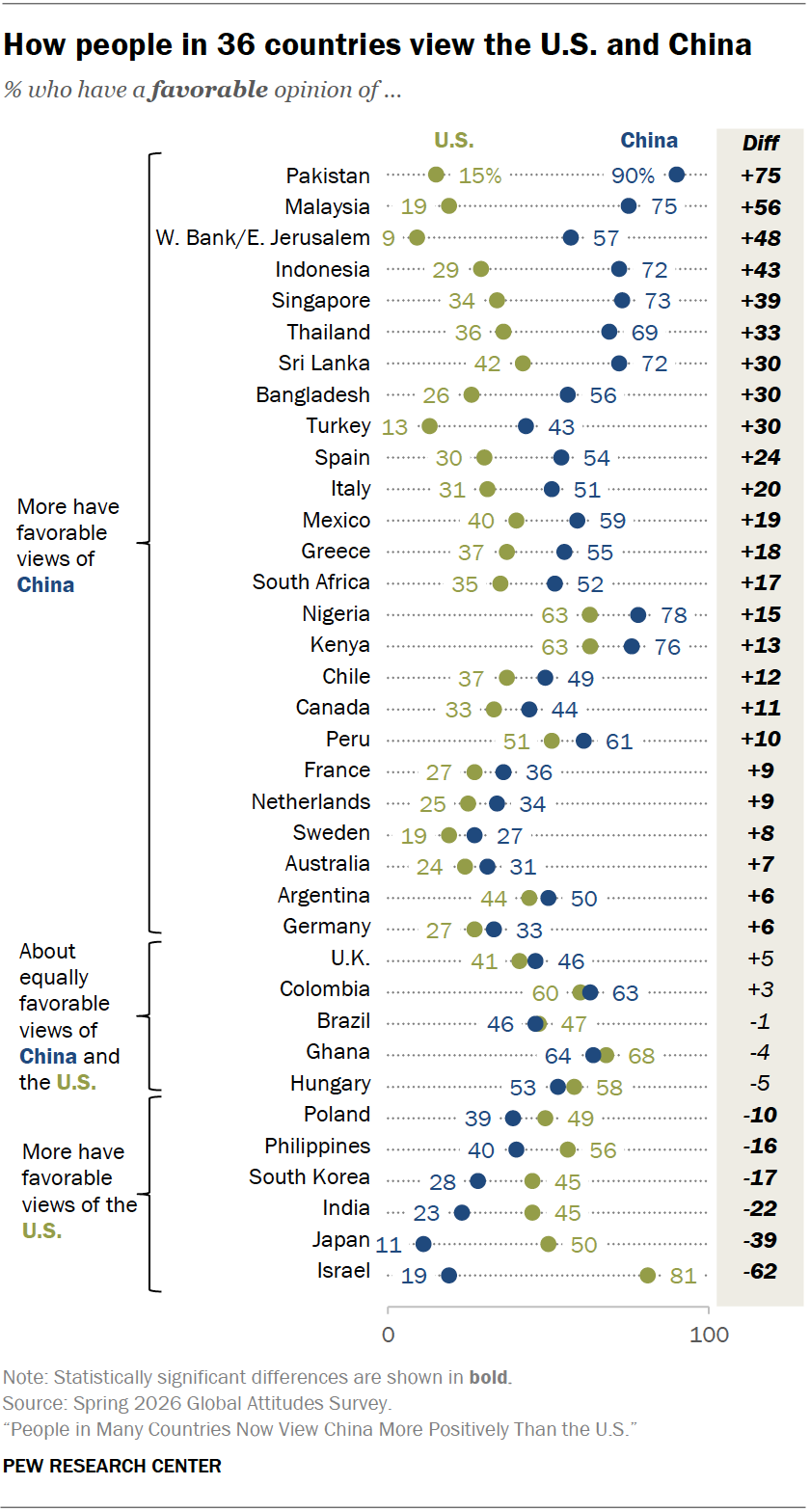
China is now viewed more favorably than the U.S. in 25 of 36 countries

Pew found a recent reversal driven by improving views of China and worsening views of the United States across much of the world.

Pew surveyed 42,151 adults across 36 countries from Feb. 8 to May 13, 2026. China led the United States on favorability in 25 countries; the U.S. led in six.

ContextThe favorability reversal does not extend to every measure. Across the 36-country survey, more people still said the U.S. government respects personal freedoms than said the same of China, although that advantage narrowed as assessments of the U.S. fell in nearly every country surveyed since 2021. Confidence in both Donald Trump and Xi Jinping was generally low, even though Xi led Trump in more countries.

PEW RESEARCH CENTER3 sources

9not newsworld

U.S. and Japan intervene to strengthen the yen after a 40-year low

The coordinated move pulled the dollar below ¥156 after it traded above ¥163.

Japan’s Finance Ministry bought yen in coordination with the U.S. Treasury after the dollar climbed above ¥163, its strongest level against the yen in 40 years. The dollar fell to about ¥155.20 after the intervention was announced.

ContextBecause Japan imports much of what it consumes, a weaker yen raises domestic prices; high oil prices have intensified that burden. A weaker dollar, meanwhile, makes U.S.-made goods less expensive in yen and could support American exports to Japan. The underlying pressure has not disappeared. The Bank of Japan’s benchmark rate is 1%, compared with the Federal Reserve’s 3.5%–3.75% range, encouraging investors to favor higher-yielding dollar assets.

AP1 source

Tuesday · The daily brief

Aug 42026

9 leads22 briefs17 min

Listen

AI narration

The whole issue in a few minutes · 3:39 at 1×

Transcript

Executive summary9 stories

News news6

  1. Blanche scraps a $1.8 billion political-targeting claims fund and wins two GOP confirmation votesThe still-unopened fund came from Trump's IRS settlement and would have let a DOJ commission pay people alleging political targeting.
  2. Israel raises ‘serious security concerns’ over Hamas disarmament dealThe roadmap would move a stalled October ceasefire into its disarmament-and-withdrawal phase.
  3. Iran denies Trump’s claim that new U.S. talks would start MondayTrump said negotiations would begin Monday afternoon after he held off on threatened strikes; Iran’s Foreign Ministry said no talks or delegation were scheduled.
  4. Zelensky says Russia launched nearly 1,900 drones at Ukraine in one weekPresident Volodymyr Zelensky said 16 regions were attacked and more than 1,500 sites were damaged during the week.
  5. Spain updates Ceuta death toll as it installs sea barrierSpanish authorities raised the count from 67 deaths Saturday to 72 deaths Sunday as searches continued.
  6. California Democrats endorse a one-time tax equal to 5% of billionaire wealthProposition 40 could raise tens of billions for health care, but the hardest questions are how California would value private fortunes and what happens after the one-time money is gone.

Not news news3

  1. Tariffs raised prices for imported and U.S.-made goods—with the biggest policy exposure in metals and autosAn NBER working paper estimates 26% pass-through to consumer-goods prices and says indirect increases took nine to 12 months to arrive.
  2. China is now viewed more favorably than the U.S. in 25 of 36 countriesPew found a recent reversal driven by improving views of China and worsening views of the United States across much of the world.
  3. U.S. and Japan intervene to strengthen the yen after a 40-year lowThe coordinated move pulled the dollar below ¥156 after it traded above ¥163.

News news6 stories

1.) AP: Blanche scraps a $1.8 billion political-targeting claims fund and wins two GOP confirmation votes

The still-unopened fund came from Trump's IRS settlement and would have let a DOJ commission pay people alleging political targeting.
Figure 1Chart

The fund DOJ scrapped was more than twice its own cited precedent

The money was to come from the Treasury's Judgment Fund, a permanent appropriation, rather than a new line item voted by Congress.

The fund DOJ scrapped was more than twice its own cited precedentTwo bars: the $1.776 billion Anti-Weaponization Fund the Justice Department rescinded, and the $760 million Keepseagle farm-discrimination settlement it had cited as precedent. At Anti-Weaponization Fund, a note reads "Never opened: no commissioners or applicants".
The numbers
The fund DOJ scrapped was more than twice its own cited precedent
Millions of dollarsSettlement sizeNote
Anti-Weaponization Fund$1,776proposed, then rescinded before it opened
Keepseagle settlement$760farm discrimination; cited by DOJ as precedent

The rescission killed the commission and its potential payouts, but did not unwind every part of the settlement. Blanche preserved a separate order protecting Trump, his adult sons and the Trump Organization from liability tied to past tax conduct; it does not cover returns filed after the settlement.

Ongoing1 earlier update

This story has run 2 times over 5 days, starting Jul 30.

  1. Trump says Hamas agreed to phased disarmament in Gaza; Israel remains skeptical
  2. Israel raises ‘serious security concerns’ over Hamas disarmament deal — this issue

2.) NBC NEWS: Israel raises 'serious security concerns' over Hamas disarmament deal

The roadmap would move a stalled October ceasefire into its disarmament-and-withdrawal phase.
Ongoing2 earlier updates

This story has run 3 times over 12 days, starting Jul 23.

  1. Trump Threatens to Bomb Iranian Bridges and Power Plants for Every Ship Hit in Strait of Hormuz
  2. Iran fires multiple ballistic missiles at U.S. base in Jordan; all are intercepted
  3. Iran denies Trump’s claim that new U.S. talks would start Monday — this issue

3.) AP: Iran denies Trump's claim that new U.S. talks would start Monday

Trump said negotiations would begin Monday afternoon after he held off on threatened strikes; Iran's Foreign Ministry said no talks or delegation were scheduled.

Trump's decision to pause the threatened strikes reduced the market's near-term estimate of supply disruption, even though the war and the Strait of Hormuz remain major risks for energy prices.

Ongoing2 earlier updates

This story has run 3 times over 8 days, starting Jul 27.

  1. Zelensky will meet senators Tuesday as Russia sanctions vote nears
  2. Senate advances sweeping Russia-Iran sanctions bill 86-12
  3. Zelensky says Russia launched nearly 1,900 drones at Ukraine in one week — this issue

4.) VOLODYMYR ZELENSKY: Zelensky says Russia launched nearly 1,900 drones at Ukraine in one week

The Ukrainian president said 16 regions were attacked and more than 1,500 sites were damaged during the week.
Figure 1Chart

The week's increase was in missiles, the smallest of the three counts

Drones are up about 12% and missiles about 52%; the bomb count is roughly flat. Both weeks are Zelensky's own tallies, and POLI did not find an independent weekly count in the cited sources.

The week's increase was in missiles, the smallest of the three countsGrouped bars comparing two consecutive weeks of reported Russian attacks on Ukraine: 1,900 attack drones against 1,700 a week earlier, 1,600 guided aerial bombs against 1,630, and 144 missiles against 95.
Latest weekWeek earlier
The numbers
The week's increase was in missiles, the smallest of the three counts
Weapons launched, as reportedLatest weekWeek earlierNote
Attack drones1,9001,700reported as roughly 1,900; reported as nearly 1,700
Guided aerial bombs1,6001,630reported as nearly 1,600; reported as more than 1,630
Missiles14495

Zelensky reported nearly 1,700 Russian drones, more than 1,630 guided bombs and 95 missiles during the preceding week.

Ongoing1 earlier update

This story has run 2 times over 3 days, starting Aug 1.

  1. 60,000 migrants reach Ceuta over two days; Spain begins mass returns
  2. Spain updates Ceuta death toll as it installs sea barrier — this issue

5.) AP: Spain updates Ceuta death toll as it installs sea barrier

Spanish authorities raised the count from 67 deaths Saturday to 72 deaths Sunday as searches continued.

The barrierMap

500 metres of a 7.6 km border

Spain's answer to the rush is a floating barrier along Ceuta's sea border. Drawn to scale against the boundary it reinforces.

A close map of Ceuta and its land border with Morocco, with a scale bar showing the 500 m floating barrier against the 7.6 km boundary. Places marked: Ceuta; Border, south end; Border, north end. Figures: deaths confirmed by Sunday, 72; arrivals from Morocco on 30–31 July, ≈60,000; of floating barrier, 500 m; of land border with Morocco, 7.6 km. A scale bar shows the floating barrier Spain installed along Ceuta's sea border.

72deaths confirmed by SundayRaised from 67 on Saturday as searches continued; drownings and a stampede.
≈60,000arrivals from Morocco on 30–31 July
500 mof floating barrierRises 30–70 cm above the water and extends up to a metre below it.
7.6 kmof land border with MoroccoMeasured along the OpenStreetMap boundary geometry drawn on this map. Not a reported figure.
Boundary and coastline: OpenStreetMap. The barrier is shown as a scale bar — its alignment was not published.
What this map shows, as data
Places marked on the map
PlaceRolePositionWhat the reporting saysSource
CeutaPlace35.89°N, 5.31°WSpanish autonomous city on the North African coast, bordered by Morocco on three sides and the Mediterranean on the fourth.OpenStreetMap contributors (ODbL)
Border, south endChokepoint35.87°N, 5.34°WWhere the land border meets the Mediterranean. Entrants were reported reaching Ceuta by swimming around the barriers here and by scaling the fences.OpenStreetMap contributors (ODbL)
Border, north endChokepoint35.91°N, 5.38°WThe border's other terminus, on the Strait of Gibraltar shore.OpenStreetMap contributors (ODbL)
Figures shown beside the map
FigureValueDetailSource
deaths confirmed by Sunday72Raised from 67 on Saturday as searches continued; drownings and a stampede.AP: Spain installs 500-metre barrier at Ceuta
arrivals from Morocco on 30–31 July≈60,000AP: Spain installs 500-metre barrier at Ceuta
of floating barrier500 mRises 30–70 cm above the water and extends up to a metre below it.France 24/Reuters: Spain installs floating barrier in Ceuta
of land border with Morocco7.6 kmMeasured along the OpenStreetMap boundary geometry drawn on this map. Not a reported figure.OpenStreetMap contributors (ODbL)

Where every coordinate came from

  • Coordinates: Natural Earth 1:10m populated places, Admin-1 capital “Ceuta”. Boundary: OpenStreetMap relation 1154756.
  • Southern terminus of the Ceuta–Morocco boundary in OpenStreetMap relation 1154756.
  • Northern terminus of the Ceuta–Morocco boundary in OpenStreetMap relation 1154756.
  • Length as reported by AP (500 m, “about one-third of a mile”). Drawn as a scale bar rather than sited on the map: the alignment was not published.

Sources: AP: Spain installs 500-metre barrier at Ceuta · France 24/Reuters: Spain installs floating barrier in Ceuta · OpenStreetMap contributors (ODbL) · Natural Earth (public domain)

Figure 1Figures

Seventy-two dead among roughly sixty thousand who crossed

Drownings and stampede deaths are counted together; the reporting does not break them out. Spain has since installed a 500-metre floating barrier along Ceuta's sea border.

Confirmed dead
72
confirmed by Sunday, revised up from 67 on Saturday as searches continued
Arrivals
60,000
roughly this many crossed from Morocco on July 30 and 31
The numbers
Seventy-two dead among roughly sixty thousand who crossed
MeasurePeopleNote
Confirmed dead72confirmed by Sunday, revised up from 67 on Saturday as searches continued
Arrivals60,000roughly this many crossed from Morocco on July 30 and 31

6.) NEW YORK TIMES: California Democrats endorse a one-time tax equal to 5% of billionaire wealth

Proposition 40 could raise tens of billions for health care, but the hardest questions are how California would value private fortunes and what happens after the one-time money is gone.

For the tax

California's Legislative Analyst's Office says the levy would probably raise tens of billions of dollars over several years from a few hundred people. Ninety percent must go to public health care, with the rest for education, food assistance and administration. Supporters argue that asking people with extraordinary ability to pay is preferable to cutting Medi-Cal or shifting the bill to ordinary taxpayers.

Because it is a one-time levy on wealth already accumulated, it does not permanently raise the tax on future investment returns. The OECD says a surprise capital levy can therefore be less economically distortive in theory, although successful examples are rare. The Jan. 1 residency rule also means moving later in 2026 would not erase the bill.

Against the tax

California does not already receive a clean net-worth figure on income-tax returns. Public stock is easy to price; private companies, trusts and intellectual property are not. The measure would invite long disputes over ownership, debt, control and fair value, while giving the Franchise Tax Board broad rulemaking and enforcement authority.

A billionaire on paper may not have $50 million in cash for every $1 billion of wealth, making sales or long deferrals more likely. The money is also temporary while health-care costs recur. The LAO expects departures and other responses could reduce ongoing income-tax revenue by less than $1 billion a year, so California would trade a large, uncertain windfall now for some risk to a highly concentrated future tax base.

Quick bites21

  1. Head Start standards targeted

    The administration is considering cutting 122 pages of federal standards to about a dozen and leaving most staffing and safety rules to states. The proposal is not public and would require comment before adoption.

    Figure 1Chart

    A 122-page rulebook would become about a dozen pages

    Most staffing and safety rules would pass to the states. The proposal is not public and would require a comment period before adoption; “about a dozen” is drawn here as twelve.

    A 122-page rulebook would become about a dozen pagesTwo bars: 122 pages of current federal Head Start standards, against about a dozen pages under the proposal the administration is considering. At Current standards, a note reads "Include medical, dental and vision screenings".
    The numbers
    A 122-page rulebook would become about a dozen pages
    Pages of federal standardsFederal standardsNote
    Current standards122
    Under the proposal12reported as “about a dozen”
  2. DOJ task-force safeguards

    DOJ can let state and local officers serve warrants before federal training and has no department-wide criteria for when misconduct should remove them. GAO recommends uniform training and removal guidance.

  3. Michigan reports first Cyclospora deaths

    Michigan reported the first two deaths associated with a multistate Cyclospora outbreak that has caused 11,234 illnesses and been linked by federal officials to iceberg lettuce. Both people who died had significant underlying health conditions.

  4. Ethics panel seeks Edwards censure

    The bipartisan House Ethics Committee recommended censuring Chuck Edwards (Rep-R North Carolina) over his treatment of two female staffers in their 20s. Its 25-page report described gifts, comments about the staffers’ appearance and invitations the panel characterized as intimate, finding that the conduct violated House rules and the spirit of prohibitions on sexual harassment and unwanted advances. Edwards’ attorneys said he was cleared of sexual misconduct and quid-pro-quo harassment.

7 more quick bitesSame day, same run — headlines only until you open one
  1. Clayton takes intelligence post

    Jay Clayton was sworn in as director of national intelligence after a days-long handoff delay. Acting director Bill Pulte began transferring control after a weekend of questions about why he remained in the job. During his brief tenure, Pulte said the Office of the Director of National Intelligence had cut staffing by about 30% from its level several weeks earlier, though he did not release details that would allow the figure to be independently verified.

    Ongoing2

    This story has run 3 times over 8 days, starting Jul 27.

    1. Senate advances Jay Clayton for intelligence chief, 51–43
    2. Senate confirms Jay Clayton as intelligence chief in 51-47 party-line vote
    3. Clayton takes intelligence post — this issue
  2. White House keeps its new AI pre-release rules private

    The voluntary framework could give the government up to 30 days of access to advanced AI models before other trusted partners see them. The White House says the rules are finished, but has not disclosed which models qualify, which labs helped write them or when any company will use them.

  3. Kaptur hurt in hit-and-run

    Marcy Kaptur (Rep-D Ohio) was hospitalized with non-life-threatening injuries after a hit-and-run driver struck the vehicle carrying her to a Sunday church service in Toledo. Her spokesperson said she was alert and receiving treatment.

  4. Reflecting pool charges dropped

    U.S. Attorney Jeanine Pirro dropped charges against Olympian David Hearn and at least three others after evidence attributed damage at the Lincoln Memorial Reflecting Pool to a faulty installation rather than vandalism. President Donald Trump criticized the decision, saying Pirro “choked” and “folded like an umbrella.”

  5. Cognitive decline can be missed by long-term-care screens

    A Dutch study found that 42% of cognitively impaired older adults living in the community used no formal or informal long-term care. That is not evidence they were denied care: the authors say many may manage on their own, and reported unmet need is low in the Netherlands. The useful warning is that cognition predicted care use beyond physical and functional limitations, so a program that asks mainly whether someone can bathe, dress or move around may miss a different kind of need.

  6. Senate advances shutdown patch

    Senate appropriators unveiled a bipartisan bill that would keep federal agencies funded at roughly current levels through Dec. 11, averting an Oct. 1 shutdown if enacted and postponing broader negotiations until after the midterms. The measure would also temporarily block the Trump administration’s plan to shift greater control over scientific grants to political appointees.

  7. UEFA threatens FIFA with legal action

    UEFA warned FIFA it could sue over Gianni Infantino’s failed attempt to transfer World Cup commercial rights into a new venture—an unusually public fight over who controls the tournament’s media and sponsorship business.

Elections10 races

Congressional control

Who ends up holding each chamber

Aug 4, 10:40 AM CT
7-day replay

U.S. House: chance of Democratic control of the House, Polymarket 87%, Kalshi 84%. U.S. Senate: chance Democrats take it, Polymarket 46%, Kalshi 47%. Full day-by-day figures are in the table below.

U.S. HouseDemocratic control7 days ago · Democrats favoured
86%84%chance of Democratic control of the House · 1.5pp apart
U.S. House: chance of Democratic control of the House. 7 days ago, Polymarket 86% and Kalshi 84%. Today it stands at Polymarket 87% and Kalshi 84%.
U.S. SenateDemocrats take it7 days ago · Republicans favoured
44%chance Democrats take it · one venue, no gap
U.S. Senate: chance Democrats take it. 7 days ago, Kalshi 44%. Today it stands at Polymarket 46% and Kalshi 47%.
7 days ago
How to read thisthe contract, the key, and the week panel

Each bar is one contract: will Democrats control this chamber after the 2026 midterms. The Republican share is the arithmetic complement of that price, not a separately traded market. Republicans hold the Senate, so the figure printed there is the chance Democrats take it. This desk has not established who is defending the House, so that bar stays in the market’s own words and claims nothing about who would be losing it. Two venues price each contract; where they differ the lighter wedge is how far apart they are, and the panel on the right is the week.

  • two venues, priced separately
  • shaded = how far apart they are
  • 50% — control flips here
  • the last 7 days, on its own scale
  • Polymarket, solid
  • Kalshi, dashed

Both lines in a week panel are the same contract, priced by two venues — not one line per party. Its colour is whose chance the bar is measuring, which is why a panel can be blue while the verdict beside it reads Republicans favoured.

3 of 10 races. Open one, or all of them — every race is on the page either way.

  • oAlaska Senate generalAlaska SenateMary Peltola 55.5%Dan Sullivan 45.0%

    POLYMARKET: Alaska Senate

    Democrat Mary Peltola is challenging Republican Sen. Dan Sullivan.

    Two markets, one question

    Alaska Senate general

    Aug 4, 10:40 AM CT
    widest venue gap 1.0pp
    • Polymarket, solid
    • Kalshi, dashed
    • shaded = the gap between them

    Alaska Senate general. Mary Peltola (D): Polymarket 55.5%; Dan Sullivan (R): Polymarket 44.5%, Kalshi 45.5%. Widest disagreement between the two venues: 1.0pp. Full history is in the table below.

    7 days ago

    Market-implied chance of winning, out of 100 — prices, not polls. Source: Polymarket · Kalshi.

  • pIowa Senate generalIowa SenateAshley Hinson 56.5%Josh Turek 44.0%

    POLYMARKET: Iowa Senate

    Ashley Hinson and Josh Turek are running for Joni Ernst’s open seat.

    Two markets, one question

    Iowa Senate general

    Aug 4, 10:40 AM CT
    widest venue gap 3.0pp
    • Polymarket, solid
    • Kalshi, dashed
    • shaded = the gap between them

    Iowa Senate general. Ashley Hinson (R): Polymarket 55.5%, Kalshi 57.5%; Josh Turek (D): Polymarket 45.5%, Kalshi 42.5%. Widest disagreement between the two venues: 3.0pp. Full history is in the table below.

    7 days ago

    Market-implied chance of winning, out of 100 — prices, not polls. Source: Polymarket · Kalshi.

  • mMaine Senate generalMaine SenateTroy Jackson 65.5%Susan Collins 35.0%

    POLYMARKET: Maine Senate

    Susan Collins faces Troy Jackson, selected after the Democratic primary winner withdrew.

    Two markets, one question

    Maine Senate general

    Aug 4, 10:40 AM CT
    widest venue gap 4.0pp
    • Polymarket, solid
    • Kalshi, dashed
    • shaded = the gap between them

    Maine Senate general. Troy Jackson (D): Polymarket 67.5%, Kalshi 63.5%; Susan Collins (R): Polymarket 33.5%, Kalshi 36.5%. Widest disagreement between the two venues: 4.0pp. Full history is in the table below.

    7 days ago

    Market-implied chance of winning, out of 100 — prices, not polls. Source: Polymarket · Kalshi.

    These contracts price the party, not the named person — the venues list the seat before the nominee is settled.

The other 7 races10 consequential races · Aug 4, 10:40 AM CT · markets, not polling

Senate3 of 6

  • qMichigan Senate generalMichigan SenateAbdul El-Sayed 65.3%Mike Rogers 35.3%

    POLYMARKET: Michigan Senate

    Gary Peters is retiring; Mike Rogers is the GOP nominee while Democrats vote Aug. 4.

    Two markets, one question

    Michigan Senate general

    Aug 4, 10:40 AM CT
    widest venue gap 1.5pp
    • Polymarket, solid
    • Kalshi, dashed
    • shaded = the gap between them

    Michigan Senate general. Abdul El-Sayed (D): Polymarket 66.0%, Kalshi 64.5%; Mike Rogers (R): Polymarket 35.0%, Kalshi 35.5%. Widest disagreement between the two venues: 1.5pp. Full history is in the table below.

    7 days ago

    Market-implied chance of winning, out of 100 — prices, not polls. Source: Polymarket · Kalshi.

    These contracts price the party, not the named person — the venues list the seat before the nominee is settled.

  • rOhio Senate generalOhio SenateSherrod Brown 52.0%Jon Husted 48.3%

    POLYMARKET: Ohio Senate

    Sherrod Brown faces Jon Husted in a Nov. 3 special election.

    Two markets, one question

    Ohio Senate general

    Aug 4, 10:40 AM CT
    widest venue gap 3.0pp
    • Polymarket, solid
    • Kalshi, dashed
    • shaded = the gap between them

    Ohio Senate general. Sherrod Brown (D): Polymarket 50.5%, Kalshi 53.5%; Jon Husted (R): Polymarket 49.5%, Kalshi 47.0%. Widest disagreement between the two venues: 3.0pp. Full history is in the table below.

    7 days ago

    Market-implied chance of winning, out of 100 — prices, not polls. Source: Polymarket · Kalshi.

  • nTexas Senate generalTexas SenateKen Paxton 52.5%James Talarico 47.3%

    POLYMARKET: Texas Senate

    Republican Ken Paxton faces Democrat James Talarico.

    Two markets, one question

    Texas Senate general

    Aug 4, 10:40 AM CT
    widest venue gap 2.0pp
    • Polymarket, solid
    • Kalshi, dashed
    • shaded = the gap between them

    Texas Senate general. Ken Paxton (R): Polymarket 51.5%, Kalshi 53.5%; James Talarico (D): Polymarket 48.0%, Kalshi 46.5%. Widest disagreement between the two venues: 2.0pp. Full history is in the table below.

    7 days ago

    Market-implied chance of winning, out of 100 — prices, not polls. Source: Polymarket · Kalshi.

Governors4

  • tGeorgia governor generalGeorgia governorKeisha Lance Bottoms 58.5%Rick Jackson 41.3%

    POLYMARKET: Georgia governor

    Democrat Keisha Lance Bottoms faces Republican Rick Jackson for Georgia's open governor seat.

    Two markets, one question

    Georgia governor general

    Aug 4, 10:40 AM CT
    widest venue gap 0.5pp
    • Polymarket, solid
    • Kalshi, dashed
    • shaded = the gap between them

    Georgia governor general. Keisha Lance Bottoms (D): Polymarket 58.5%, Kalshi 58.5%; Rick Jackson (R): Polymarket 41.0%, Kalshi 41.5%. Widest disagreement between the two venues: 0.5pp. Full history is in the table below.

    7 days ago

    Market-implied chance of winning, out of 100 — prices, not polls. Source: Polymarket · Kalshi.

    These contracts price the party, not the named person — the venues list the seat before the nominee is settled.

  • uNevada governor generalNevada governorAaron Ford 55.5%Joe Lombardo 44.8%

    POLYMARKET: Nevada governor

    Democrat Aaron Ford is challenging Republican Gov. Joe Lombardo.

    Two markets, one question

    Nevada governor general

    Aug 4, 10:40 AM CT
    widest venue gap 2.5pp
    • Polymarket, solid
    • Kalshi, dashed
    • shaded = the gap between them

    Nevada governor general. Aaron Ford (D): Polymarket 55%, Kalshi 56%; Joe Lombardo (R): Polymarket 46.0%, Kalshi 43.5%. Widest disagreement between the two venues: 2.5pp. Full history is in the table below.

    7 days ago

    Market-implied chance of winning, out of 100 — prices, not polls. Source: Polymarket · Kalshi.

    These contracts price the party, not the named person — the venues list the seat before the nominee is settled.

  • lOhio governor generalOhio governorVivek Ramaswamy 53.8%Amy Acton 46.5%

    POLYMARKET: Ohio governor

    Republican Vivek Ramaswamy faces Democrat Amy Acton for an open seat; markets give the GOP only a modest edge.

    Two markets, one question

    Ohio governor general

    Aug 4, 10:40 AM CT
    widest venue gap 5.0pp
    • Polymarket, solid
    • Kalshi, dashed
    • shaded = the gap between them

    Ohio governor general. Vivek Ramaswamy (R): Polymarket 56.0%, Kalshi 51.5%; Amy Acton (D): Polymarket 44%, Kalshi 49%. Widest disagreement between the two venues: 5.0pp. Full history is in the table below.

    7 days ago

    Market-implied chance of winning, out of 100 — prices, not polls. Source: Polymarket · Kalshi.

    These contracts price the party, not the named person — the venues list the seat before the nominee is settled.

  • sWisconsin governor generalWisconsin governorHong51.0%Tiffany51.5%books splitTom Tiffany 50.5%Francesca Hong 49.8%

    POLYMARKET: Wisconsin governor

    Open seat; Francesca Hong leads the Aug. 11 Democratic primary, while Tom Tiffany is the likely GOP nominee.

    The books name different leaders

    Wisconsin governor general

    Each line is one book’s lead — the gap between the two candidates, signed. Zero is a tie, and the two venues are on opposite sides of it.

    Aug 4, 10:40 AM CT
    widest venue gap 2.5pp

    Wisconsin governor general. Lead in percentage points, positive to Tom Tiffany. Kalshi: Tiffany ahead by 3 points. Polymarket: Hong ahead by 1.5 points. Every day is in the table below.

    Tiffany aheadHong ahead10%tied10%20%7d agotodayTiffany +3%KalshiHong +1.5%Polymarket

    today

    • Tiffany+3%Kalshi
    • Hong+1.5%Polymarket
    • Tiffany49.5%Polymarket
    • Tiffany51.5%Kalshi
    • Hong51.0%Polymarket
    • Hong48.5%Kalshi

    Market-implied chance of winning, out of 100 — prices, not polls. The lead is the gap between the two, in points. Source: Polymarket · Kalshi.

Prices captured Aug 4, 10:40 AM CT. These are trader-implied estimates, not polls. Separate contracts trade independently, so opposing prices may not add to exactly 100%.

Not news news3 stories

7.) NBER: Tariffs raised prices for imported and U.S.-made goods—with the biggest policy exposure in metals and autos

An NBER working paper estimates 26% pass-through to consumer-goods prices and says indirect increases took nine to 12 months to arrive.
Figure 1Chart

Most of a tariff's price effect arrives on imported finished goods

The paper's illustrative case is a uniform 10% tariff, which it estimates would raise consumer-goods prices about 2.6%. These are the three components of that figure; they sum to 2.64 points. It is a July 2026 working paper and has not been peer reviewed.

Most of a tariff's price effect arrives on imported finished goodsThree bars of the estimated effect of a uniform 10 percent tariff on consumer-goods prices: 1.7 percentage points from imported finished goods, 0.77 points from imported inputs used by U.S. producers and 0.17 points from domestic firms raising markups. At Imported finished goods, a note reads "Arrived at the border almost immediately".
The numbers
Most of a tariff's price effect arrives on imported finished goods
Percentage points added to consumer-goods pricesPrice effectNote
Imported finished goods1.70 ppthe border-price effect appeared almost immediately
Imported inputs0.77 ppused by U.S. producers; took nine to 12 months to arrive
Domestic markups0.17 ppU.S. firms raising markups; took nine to 12 months to arrive

8.) PEW RESEARCH CENTER: China is now viewed more favorably than the U.S. in 25 of 36 countries

Dot plot comparing favorable views of the United States and China across 36 countriesDot plot comparing favorable views of the United States and China across 36 countries

Notable results: Canada moved from U.S. 57% / China 14% in 2023 to U.S. 33% / China 44% in 2026. Mexico registered China 59% / U.S. 40%. The United States still led in India, Japan, the Philippines and South Korea.

Source: Pew Research Center, Spring 2026 Global Attitudes Survey.

Figure 1Chart

Canada's view of the two countries changed places in three years

Pew surveyed 42,151 adults across 36 countries between Feb. 8 and May 13, 2026. China led the U.S. on favorability in 25 of them; the U.S. led in six.

Canada's view of the two countries changed places in three yearsGrouped bars of Pew favorability ratings: in Canada, 57 percent viewed the United States favorably and 14 percent viewed China favorably in 2023, against 33 percent and 44 percent in 2026; in Mexico in 2026, 40 percent viewed the United States favorably and 59 percent China. At Mexico, 2026, a note reads "2026 only — the reporting gives no earlier Mexico reading".
United StatesChina
The numbers
Canada's view of the two countries changed places in three years
Share with a favorable viewUnited StatesChina
Canada, 202357%14%
Canada, 202633%44%
Mexico, 202640%59%

An NBER working paper finds presidential rhetoric about China became markedly more negative after the early 2000s, converging with already-negative congressional, media, social-media and think-tank language. The authors find evidence of bottom-up diffusion across institutions, not that presidents alone set the national tone.

9.) AP: U.S. and Japan intervene to strengthen the yen after a 40-year low

The coordinated move pulled the dollar below ¥156 after it traded above ¥163.
Figure 1Chart

The rate gap behind the yen's slide did not move

Tokyo and Washington bought yen after the dollar traded above ¥163, its strongest in 40 years; it fell to about ¥155.20. The differential that draws money into dollar assets is unchanged.

The rate gap behind the yen's slide did not moveTwo bars comparing the Federal Reserve's target range, drawn at its 3.75 percent top with a reference line at its 3.5 percent bottom, with the Bank of Japan's 1 percent benchmark rate. A reference line at 3.5 is labelled "The Fed's range: 3.5% here, 3.75% at the bar".
The numbers
The rate gap behind the yen's slide did not move
Benchmark policy rateBenchmark rateNote
Federal Reserve3.75%top of a 3.5%–3.75% target range
Bank of Japan1.00%

Trump’s comments1

What Trump said today, from policy conditions to off-the-cuff remarks.

  1. Trump praises yen intervention, then invokes Pearl Harbor

    Trump called U.S. support for Japan’s currency intervention a “signal of friendship,” then said Japan had been good to the United States “with the exception, of course, of Pearl Harbor.”