Washington withheld specific measures against Beijing as Trump prepares to host President Xi Jinping next month.
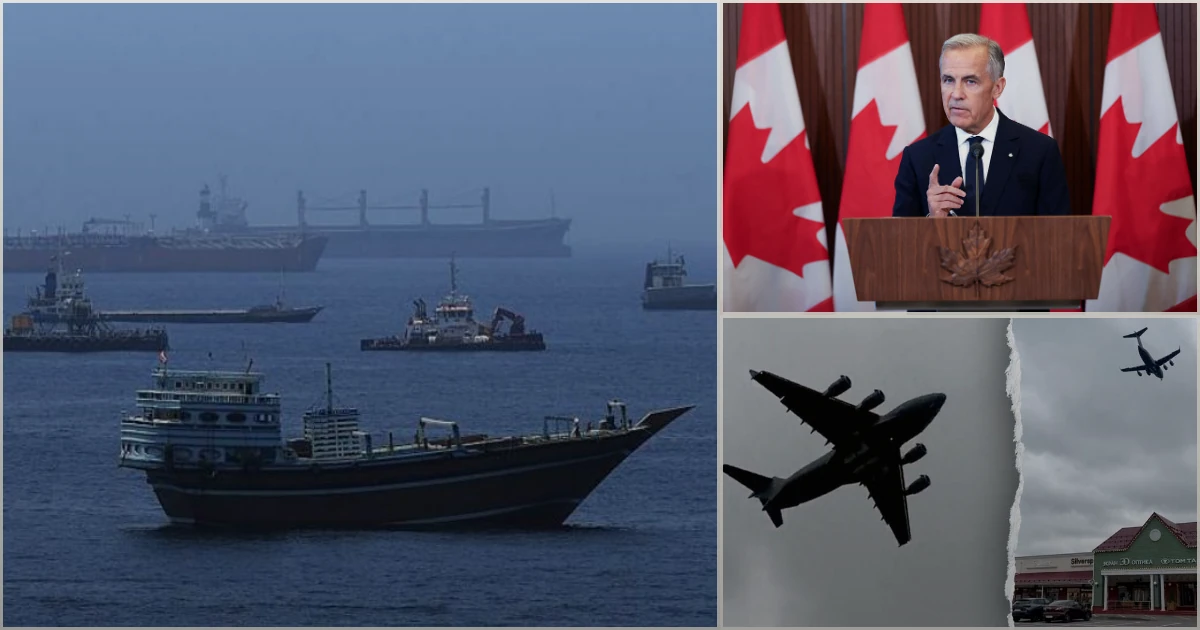
Beijing vowed to protect its interests and warned that the administration’s campaign of “economic warfare” could disrupt the global economy. U.S. officials said they would privately engage countries that continue doing business with Iran.
ContextChina receives more than 80% of Iran’s oil shipments, making Beijing the central test of efforts to cut Tehran’s trade.
Canada will tariff more than 700 U.S. products starting Sept. 8 after Washington imposed its own 50% levies.
The United States imposed 50% tariffs on about $20 billion of Canadian goods. Canada’s countermeasure list covers more than 700 U.S. products worth nearly $20 billion, including steel, dairy, appliances, and electronics. Prime Minister Mark Carney said Washington “asked too much of Canada and offered too little in return.”
ContextFor scale, the United States exported $350.6 billion in goods to Canada in 2024; Canada’s list targets about 5.7% of that annual flow.
The rule moves forward as the first midterm ballots are due to reach North Carolina’s military and overseas voters Sept. 4.
A federal judge found that USPS violated a nationwide order when it finished the rule. He still let the agency publish it. In a separate 6-3 ruling, the Supreme Court lifted another block because the states sued before the rule took effect.
ContextThe rule requires states to send voter lists and ballot barcodes through a federal portal and redesign ballot envelopes. USPS could refuse outgoing ballot mail from states that do not comply. Neither ruling decided whether the rule itself is legal.
It was the first known visit by a CIA director since William Burns warned the Kremlin against invading Ukraine in November 2021.
Two U.S. officials told Axios that John Ratcliffe visited Moscow for talks with Russian officials, his first trip there as CIA director and the highest-level Trump administration visit to Russia since January. Neither government disclosed the subject or participants.
ContextThe previous known CIA-director visit came in November 2021, when Burns carried a warning to Vladimir Putin and senior advisers about Russia’s preparations to invade Ukraine. Russia launched its full-scale invasion three months later; Ratcliffe’s trip comes as the current Ukraine peace talks remain stalled.
DOJ linked Rep. Joyce Beatty’s challenge to the naming vote with a separate renovation, arguing donor flight could leave the building unsafe.
The filing answered Beatty’s motion after the board voted 20-3 on Aug. 13 to add Trump’s name. DOJ said an order blocking that move could drive away donors, halt structural repairs, and eventually leave the center unsafe enough to demolish and perhaps replace with an outdoor amphitheater.
ContextBeatty’s motion targets the board’s naming action; the administration says that dispute could undermine the separate structural rehabilitation. Demolition is a possible downstream outcome raised in the filing, not an approved plan.
Scott Bessent calls the purchases routine liquidity support; Stanley Druckenmiller says they amount to political price management.
Treasury will at least double its buybacks of 10- to 30-year bonds. The maximum will rise from $2 billion to at least $4 billion per operation from Sept. 9 through Nov. 4. Buying older bonds can make them easier to trade. It also reduces supply, which can lift prices and lower yields.
ContextLong Treasury yields help set mortgage and business loan rates. They also drive the federal government’s interest bill. The 30-year yield had reached a nearly 20-year high before the announcement, and the first bond rally faded fast. Analysts expect Treasury to issue nearly $550 billion in bonds this quarter. That makes a $4 billion operation small beside the financing need but large enough to send a policy signal. TD Securities called the move “the equivalent of verbal intervention from the U.S. Treasury.”
The overall index barely moved, but expectations fell 5.8 points even as views of current conditions improved.
The Consumer Confidence Index slipped 0.8 points to 89.4 in August from 90.2 in July, its lowest reading in seven months. Readings were consistently above 100 in late 2024 and early 2025. The Aug. 3–16 survey found elevated concern about prices, oil and gas, war, trade, and jobs.
ContextThe Present Situation Index rose 6.8 points to 121.2, helped by better assessments of the job market. The Expectations Index fell 5.8 points to 68.2 as respondents became more pessimistic about business conditions, employment, and household income over the next six months. The headline decline was small; the widening gap between “now” and “next” is the more useful signal.
Canada will tariff more than 700 U.S. products starting Sept. 8 after Washington imposed its own 50% levies.
Red take
Tariffs as leverage. The White House’s case is that accepting retaliation on nearly $20 billion in goods is the price of pressing Canada for terms Washington considers reciprocal. On that theory, the near-term hit is a bargaining cost if the threat changes the deal or shifts production to the United States.
Blue take
Retaliation as self-harm. Canada’s dollar-for-dollar answer puts Washington’s negotiating tactic onto more than 700 products and tightly linked supply chains. The risk is not abstract “trade friction”; it is higher prices and disrupted orders for businesses and households on both sides before either government wins a concession.
The State Department plans to revoke up to 200,000 B-1 and B-2 visas held by people who sought asylum after entering as short-term visitors. The administration says that amounts to visa fraud; it has already revoked more than 175,000 visas since Trump took office.
Two unvaccinated people in Lancaster County died of measles, the first U.S. measles deaths of 2026 and Pennsylvania’s first in 35 years. The country has confirmed 2,777 cases this year, the most since 1991; Pennsylvania has reported 393 cases, including 70 hospitalizations.
Cristy Maryori Villafranca-Trejo, wife of active-duty Army Sgt. Hedar Leonel Turcios Juarez, was deported to Honduras on Aug. 24. She is at least the seventh spouse or parent of an active-duty service member deported under Trump.
ICE released Luis Manuel Aviles from custody Tuesday after an immigration judge dismissed his case Monday. Agents arrested him Saturday while his son Joshua served a nine-month deployment aboard the USS Abraham Lincoln.
President Donald Trump plans to suspend tariffs on 300,000 metric tons of imported beef. The proposed volume is about 661 million pounds, roughly 11% of USDA’s 6.109-billion-pound forecast for total 2026 beef imports. An AP-NORC poll found 80% of Americans had changed their grocery habits because of high prices. Farm-state Republicans objected, while Agriculture Secretary Brooke Rollins said the plan remains under discussion.
DHS said its preliminary estimate of 250,000 noncitizens on voter rolls in four states was inflated. The administration had cited the figure to push for proof-of-citizenship rules. DHS did not provide a corrected estimate, so the size of the overstatement remains unknown.
Iranian state TV aired an IRGC-linked video that claimed a bounty on Barron Trump. It also alleged that someone had found a way past his security. The Secret Service said it checks anything that could threaten someone it protects, but would not discuss its security work. Iranian media have aired several threats against Trump and his family since the U.S. assassination of Ayatollah Ali Khamenei.
Saudi nuclear pact reaches Congress with Israel condition unresolved
Trump sent Congress a classified civil nuclear deal signed with Saudi Arabia last month. It would run for 30 years. Congress has 90 session days to reject it; otherwise the pact can take effect without a vote. Trump still says Riyadh must recognize Israel, but officials would not say if the document includes that condition. Federal law does not by itself bar Saudi uranium enrichment or reprocessing. Disputes over those safeguards stalled earlier talks.
Scott Bessent calls the purchases routine liquidity support; Stanley Druckenmiller says they amount to political price management.
Related reading
RELATEDDruckenmiller says Treasury is treating the symptom
Stanley Druckenmiller is a billionaire investor who worked alongside Bessent at Soros Fund Management. He called the expansion “price management” and a “mistake.” His case is that holding down yields could hurt the market’s trust in Treasury and delay the harder work of cutting the primary deficit. Treasury says the program helps trading and does not target interest rates.
Trump said the U.S. was giving “serious consideration” to renaming Lake Ontario because “we don’t expect to do much business with Ontario any longer.” The U.S. can control what federal agencies call the lake but cannot require Canada or the public to use that name; Ontario is the largest export market for more than a dozen U.S. states.
Trump’s comments1
What Trump said today, from policy conditions to off-the-cuff remarks.
Trump floats ‘Lake America’ as the Canada trade fight escalates
Trump said the U.S. was giving “serious consideration” to renaming Lake Ontario because “we don’t expect to do much business with Ontario any longer.” The U.S. can control what federal agencies call the lake but cannot require Canada or the public to use that name; Ontario is the largest export market for more than a dozen U.S. states.