Full issue
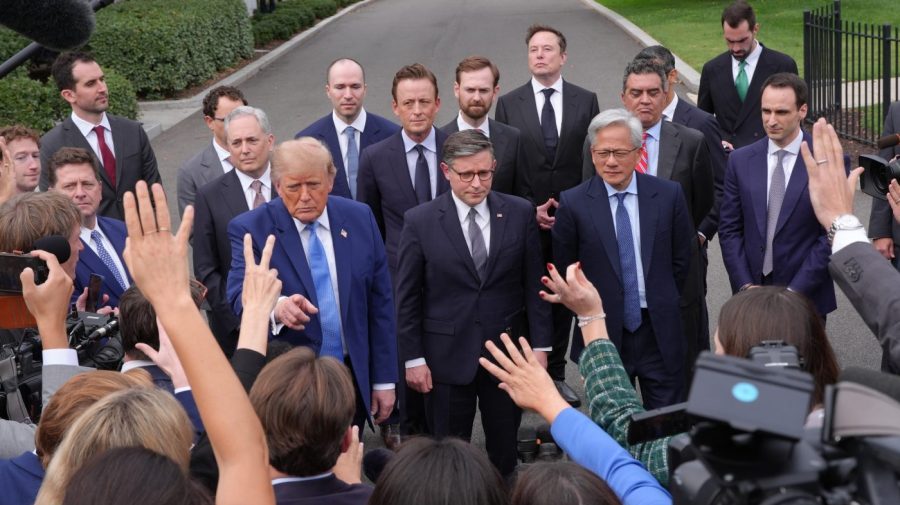
Trump stands among suited officials while reporters raise their hands and cameras outside.
The Hill
1usUpdate

Trump names DNI Jay Clayton to lead a 'super intelligence Force,' with the FTC, Pentagon tech and OPM chiefs as co-leads

Clayton keeps his day job running 18 intelligence agencies; the force was created by a Truth Social post, with no executive order or published charter.

- Sept. 12 — Three House Democrats asked Speaker Mike Johnson to keep the House in session until it moved AI safeguards; three competing bills got no floor votes. - Sept. 20 — The House left town a day early, not due back until Nov. 9, with no AI bill passed. - Sept. 29 — Trump, Johnson and the chiefs of OpenAI, Anthropic, Google, Meta, Nvidia and SpaceXAI signed a one-page voluntary safety accord with no enforcement; a separate order swapped "AI" for "Super Intelligence" in agency documents. - Oct. 1 — House Democratic leader Hakeem Jeffries (Rep-D New York) called the accord "entirely unenforceable."

ContextThe force follows a deal struck five days earlier. On Tuesday, Sept. 29, the chiefs of 6 AI companies (OpenAI, Nvidia, SpaceXAI, Google, Anthropic and Meta) signed the White House Accord on Super Intelligence. The accord is voluntary. It commits the companies to 4 layers of controls and audits, including internal evaluations, external audits and board review. Trump said the signers "almost viewed it as a separate kind of constitution." Clayton takes on the force on top of his main job as Director of National Intelligence, where he already oversees 18 intelligence agencies. The White House has had no AI czar since March 2026. That month David Sacks left the post after hitting his limit as a special government employee (a status for temporary outside advisers that caps how long they can serve each year).

THE HILL12 sources

2usUpdateIran war

Pentagon flies all 12 B-1 bombers out of RAF Fairford, the UK base tied to a suspected Iran-linked plot

The Pentagon gave no reason; a U.S. official said the base was under threat of Iranian attack.

- Sept. 27 — Police arrested five London men in their 20s in three vans near RAF Fairford; they found petrol, no explosives, and bailed the men. - Oct. 1 — Counterterrorism police arrested a sixth suspect, a UK-Iranian dual national, in Westminster on suspicion of preparing terrorist acts. - Oct. 3 — The sixth man was bailed too, leaving all six free and none charged.

ContextFairford hosts no permanent U.S. aircraft; bombers rotate through, usually four to six at a time, under the Bomber Task Force program running since January 2018, peaking at 21 to 23 during this war before six B-52s went home in late September. Flying from Fairford halves mission times versus round trips from U.S. bases, which ran about 36 hours, per Air & Space Forces.

THE HILL6 sources

Supreme Court hears Exxon and Suncor's bid to end Boulder's climate-damage suit Monday, Oct. 5, with eight justices

With Justice Samuel Alito recused, a 4-4 tie would leave Colorado's high court ruling for Boulder in place but set no national rule.

On Sept. 28, the Court's clerk told lawyers that Justice Samuel Alito would sit out the case, without giving a reason; his 2025 disclosure lists stock in ConocoPhillips and Phillips 66, not Exxon or Suncor. Alito, 76, then said in a CBS interview that he weighed retiring after last term and will reconsider every year.

ContextBoulder filed its suit in state court in 2018, and it reaches the justices eight years later. Colorado's Supreme Court ruled 5-2 on May 12, 2025, that the Clean Air Act (the main federal air-pollution law) does not block Boulder's claims. The federal appeals court in New York took the opposite view in New York City's suit against Chevron. In 2011 the justices ruled 8-0 that the Clean Air Act ended climate suits brought under federal law. That ruling left suits under state law unresolved, and this case now poses that question. With Justice Samuel Alito recused, eight justices will vote. A 4-4 tie would leave Colorado's ruling for Boulder in place but set no rule for other courts.

CBS NEWS6 sources

Justice Samuel Alito says a “concerted effort” is trying to intimidate the Supreme Court into deciding cases differently

He named no incident or person; separately, he told CBS that political attacks, most recently Donald Trump’s, “can be quite damaging.”

On Oct. 4, Alito told CBS he thought about retiring after the term that ended in June and must weigh it every year. He said it weeks before midterm elections that decide which party controls the Senate, which confirms justices.

ContextTrump appointed all three justices he has attacked: Neil Gorsuch, Brett Kavanaugh and Amy Coney Barrett. He told Time they "voted against me too often." Sen. Ed Markey (Sen-D Massachusetts) has a plan to grow the Court to 13 justices; it has had nine since 1869. In a separate CBS interview, Alito said political attacks, most recently Trump's, "can be quite damaging." He also rejected the picture of him as angry, bitter and out for revenge, and called it unrecognizable.

WASHINGTON EXAMINER6 sources