1usUpdateIran war

U.S. hits about 100 Iranian targets; Iran fires back at American bases in four countries, and a cruise missile kills 4 at a wedding

Iranian officials count at least 18 dead along the southern coast, four of them at a wedding compound in Kuhestak; Brent crude passed $90 a barrel and no U.S. casualties were reported in the retaliation.

Aug. 30 — The U.S. destroyed two Iranian rocket launchers loaded to mine the Strait of Hormuz, its first acknowledged action inside Iran since July 29. Iran fired eight missiles at bases in Jordan; all were intercepted. Sept. 1 — American forces began hitting IRGC air-defense, radar and mine-laying sites along Iran's southern coast at noon. Trump said a larger attack was "waiting in the wings." Brent crude passed $90 a barrel. Sept. 2 — Iran said its retaliation had begun as U.S. strikes near the strait continued. Transits through Hormuz fell by half, from about 10 ships a day to five.

ContextReopening the Strait of Hormuz was never an original war aim. Trump's stated objective for six months has been preventing an Iranian nuclear weapon. The strait became the condition for ending the fighting only after shipping was disrupted this summer, and what is actually moving through it is the subject of the next story. Oman had a draft arrangement pending as of Aug. 9 involving envoys Steve Witkoff and Jared Kushner. It stalled when Tehran added demands for war compensation, full sanctions relief and release of frozen funds. No Gulf government has said whether its bases were used for the Sept. 1 strikes.

TIME15 sources

U.S. drones hit 2 Iranian tankers under a new "tanker for tanker" policy as the Navy escorts a record 40-ship convoy through Hormuz

Two Filipino sailors were killed on the Saudi tanker Sidr; the escorted convoy carried 18 million barrels, while independent trackers still put average flows at 4.19 million barrels a day against 16.63 million before the war.

The record convoy, and what it does not settle: U.S. forces shot down Iranian drones the same day while escorting what officials called the largest volume of the war: 40 commercial vessels carrying 18 million barrels, per CNN. No U.S. or commercial ship in the convoy was reported hit. Officials did not say how long the convoy took to pass through, so 18 million barrels is not a daily flow figure. (TS: the IEA put 2025 average Hormuz crude and oil-products flow at about 20 million barrels per day.) CENTCOM's June 20 release reported 55 merchant transits and more than 17 million barrels moved, without defining what counted as one convoy.

ContextThe Strait of Hormuz is the 21-mile-wide channel between Iran and Oman that every Gulf oil cargo must pass through, and about a fifth of the world's oil normally moves through it — which is why a halved day of traffic reaches the pump. About 21 million barrels a day crossed it before the war, per Kpler, so the roughly 4 million barrels aboard the two tankers attacked this week equal close to a fifth of a normal prewar day. A June memorandum let escorted commercial traffic resume; recovery has been jagged, improving in early July and falling back after fresh tanker attacks, and the EIA expected shipments to stay severely constrained through August and to recover only slowly in September — a forecast one convoy does not overturn. The IMO has logged 72 confirmed attacks on shipping in the strait since the war began — 21 in the first seven weeks, 46 by June 11 — about one every 2.6 days, killing at least 21 seafarers, including the two Filipino sailors on the Sidr. War-risk insurance for the crossing now runs 7.5% to 10% of a ship's value, roughly $7.5 million on a $100 million tanker, against 0.25% before the war.

BBC NEWS4 sources

Federal judge blocks Trump's Aug. 6 order narrowing birthright citizenship, calling it "almost certainly unconstitutional"

Judge Deborah Boardman's 35-page ruling protects a previously certified nationwide class: children born in the U.S. on or after Feb. 19, 2025 whom the order would exclude, plus their parents.

How the injunction covers people nationwide after the universal-injunction limits: Boardman used Rule 23(b)(2), which lets one injunction cover a certified class when the government treats everyone in it the same way — not a universal injunction shielding strangers to the case. The Supreme Court's restriction on universal injunctions left that class mechanism intact, and it upheld nationwide class relief in Trump v. Barbara. The ruling is preliminary: it freezes enforcement while the case proceeds, and does not finally decide whether the order is constitutional.

ContextBirthright citizenship rests on the Fourteenth Amendment and United States v. Wong Kim Ark (1898), which the government lost 6-2 after arguing a man born in San Francisco to Chinese merchant parents was not a citizen. Every administration since the 1940 and 1952 citizenship statutes recognized the rule, excepting only children of accredited diplomats and hostile occupying forces. That old diplomat exception is why the August order's second target group — children of foreign embassy workers — sits closer to settled law than its first. The Supreme Court struck down Trump's broader January 2025 order 6-3, largely because 8 U.S.C. 1401(a) — the statute that writes the traditional rule into federal law — already covered the question. A ruling on statutory grounds decides less than a constitutional one: it says the order conflicts with a law Congress wrote, without settling what the Fourteenth Amendment itself requires. That left room for the administration to try a narrower order, and it leaves the constitutional question open in this case too. Boardman's answer so far is that the new order is "almost certainly unconstitutional," but that is a preliminary judgment, not a final one.

NBC NEWS6 sources

4not newslongformUpdate

U.S. average diesel price hits $5.69 a gallon, up 54% in a year, as August inventories fall to 1980s seasonal lows

Exports of diesel and related fuels rose about 28% over the past year even as domestic stocks tightened; the price is up 33 cents in the past month alone.

A Pennsylvania school district's budget showed on Aug. 30 how war-driven diesel costs reach local spending. On Sept. 1 U.S. crude passed $90 a barrel, up 12% in a week, and the emergency oil reserve fell to 286.6 million barrels, its lowest since 1982.

ContextDiesel moves nearly every truck, freight train, tractor and delivery van in the US, so its price surfaces later in grocery and shipping bills rather than at the pump. The Federal Reserve's June 2026 Beige Book, a survey of business conditions across the country, recorded roughly 30% jumps in diesel and lubricant costs, higher fuel surcharges and firms expecting to pass costs to consumers. Today's 54% rise is nearly twice that. Federal moving contracts add 1% to freight charges for every 13-cent rise in diesel. EIA's weekly stock series starts in August 1982, and late-August stocks have not been this low since the mid-1980s.

NBC NEWS1 source

Thursday · The daily brief

Sep 32026

4 leads33 briefs21 min

Executive summary4 stories

News news3

  1. U.S. hits about 100 Iranian targets; Iran fires back at American bases in four countries, and a cruise missile kills 4 at a weddingIranian officials count at least 18 dead along the southern coast, four of them at a wedding compound in Kuhestak; Brent crude passed $90 a barrel and no U.S. casualties were reported in the retaliation.
  2. U.S. drones hit 2 Iranian tankers under a new "tanker for tanker" policy as the Navy escorts a record 40-ship convoy through HormuzTwo Filipino sailors were killed on the Saudi tanker Sidr; the escorted convoy carried 18 million barrels, while independent trackers still put average flows at 4.19 million barrels a day against 16.63 million before the war.
  3. Federal judge blocks Trump's Aug. 6 order narrowing birthright citizenship, calling it "almost certainly unconstitutional"Judge Deborah Boardman's 35-page ruling protects a previously certified nationwide class: children born in the U.S. on or after Feb. 19, 2025 whom the order would exclude, plus their parents.

Not news news1

  1. U.S. average diesel price hits $5.69 a gallon, up 54% in a year, as August inventories fall to 1980s seasonal lowsExports of diesel and related fuels rose about 28% over the past year even as domestic stocks tightened; the price is up 33 cents in the past month alone.

News news3 stories

Ongoing12 earlier updates42 days
TIMEUpdate

U.S. hits about 100 Iranian targets; Iran fires back at American bases in four countries, and a cruise missile kills 4 at a wedding

Iranian officials count at least 18 dead along the southern coast, four of them at a wedding compound in Kuhestak; Brent crude passed $90 a barrel and no U.S. casualties were reported in the retaliation.

The United States carried out its largest wave of strikes on Iran in weeks on Tuesday, Sept. 1, hitting roughly 100 targets. Tehran answered by striking American military sites in four countries: Bahrain, Iraq, Jordan and Kuwait. Iranian officials reported at least 18 people killed in the U.S. attacks along the southern coast, four of them at a wedding compound in the port town of Kuhestak. No U.S. casualties were reported. Brent crude, the global benchmark oil price, rose above $90 a barrel. Trump said the renewed operation would not last much longer, and that the November midterm election would not set his timeline. He also warned: "If the failed Nation of Iran retaliates for this very justified attack, they will be hit again at a much harder and higher level." Iranian President Mahmoud Pezeshkian said Tehran would immediately resume implementing the U.S.-Iran memorandum of understanding — the June 17 deal that called for a ceasefire and 60 days of talks — if Washington returned to its own commitments. He made that offer before the latest American strikes.

Catch upwhat happened before · 12 earlier issues
  • Aug. 30 — The U.S. destroyed two Iranian rocket launchers loaded to mine the Strait of Hormuz, its first acknowledged action inside Iran since July 29. Iran fired eight missiles at bases in Jordan; all were intercepted.
  • Sept. 1 — American forces began hitting IRGC air-defense, radar and mine-laying sites along Iran's southern coast at noon. Trump said a larger attack was "waiting in the wings." Brent crude passed $90 a barrel.
  • Sept. 2 — Iran said its retaliation had begun as U.S. strikes near the strait continued. Transits through Hormuz fell by half, from about 10 ships a day to five.
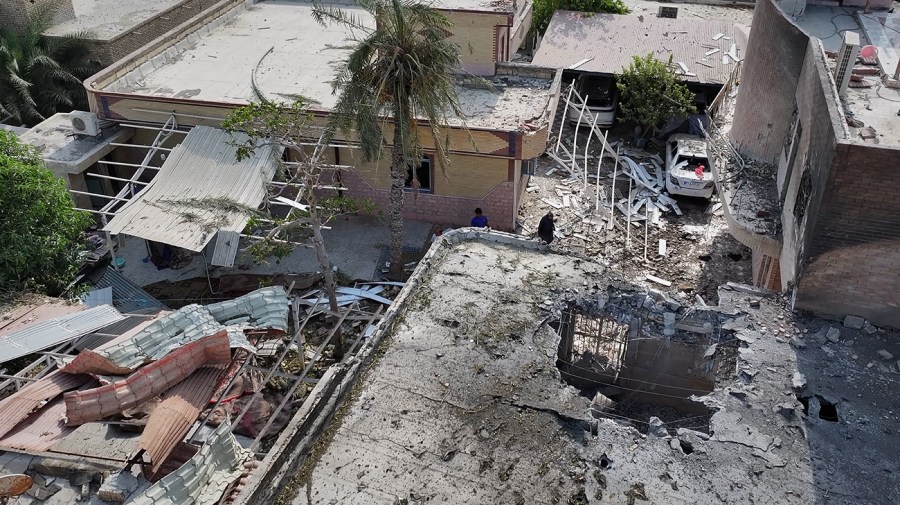
The wedding compound at KuhestakA U.S. missile struck a residential compound in the port town of Kuhestak, near the Strait of Hormuz, while a wedding was under…4 details
  • A U.S. missile struck a residential compound in the port town of Kuhestak, near the Strait of Hormuz, while a wedding was under way, according to verified footage and a New York Times weapons analysis that concluded the munition was American: fragments matching an AGM-84H/K SLAM-ER, a missile built to land within about 3 meters of its aim point.
  • Iranian sources, CBS News, the Associated Press and NBC News reported four people killed; the Times reported five. The Times and the AP put the wounded at more than 60. These dead are counted inside the at-least-18 figure for the coast, not on top of it.
  • The nearest apparent military target, a communications tower, stood roughly 100 meters from the house, per the AP. No one in the U.S. government has said the tower was the target; that is an inference drawn from where the missile landed.
  • "The missile completely destroyed the roof of the house," said Ali Mallahi, a fisherman whose daughter's wedding was being celebrated. CENTCOM spokesman Capt. Tim Hawkins said the military was reviewing the reports and would not say whether a formal civilian-harm investigation had been opened. "The U.S. military never targets civilians, unlike the IRGC," he said.
What this retaliation hit, and where the counts stopJordan: 13 ballistic missiles came in, 10 were destroyed, and three fell in remote areas with no casualties.3 details
  • Jordan: 13 ballistic missiles came in, 10 were destroyed, and three fell in remote areas with no casualties.
  • Erbil, Iraq: all 10 explosive drones were destroyed, with no casualties or ground damage; Iran's claim of hitting a repair center is unconfirmed.
  • Bahrain and Kuwait said attacks were intercepted but published no counts, so 20 of 23 — 87% — is the only interception rate that can be checked.

Related reading

Read more about: Traders put 16.5% odds on U.S. warships transiting the Strait of Hormuz by Dec. 31

On Polymarket, a betting site where the price of a contract tracks how likely traders think an event is, traders put the odds of a U.S. warship crossing the Strait of Hormuz by Dec. 31 at 16.5%. A separate contract, on whether the next U.S.-Iran meeting happens on American soil by Sept. 30, prices that at 0.2% — close to impossible.

BBC NEWS

U.S. drones hit 2 Iranian tankers under a new "tanker for tanker" policy as the Navy escorts a record 40-ship convoy through Hormuz

Two Filipino sailors were killed on the Saudi tanker Sidr; the escorted convoy carried 18 million barrels, while independent trackers still put average flows at 4.19 million barrels a day against 16.63 million before the war.

American drones struck the engine rooms of two Iranian government-owned tankers anchored north of the U.S. blockade line on Tuesday, Sept. 1, under what one U.S. official called a "tanker for tanker" policy approved by Trump. The strikes followed attacks on two commercial tankers near the Musandam peninsula, at the mouth of the Strait of Hormuz, each carrying about two million barrels of oil. Saudi Arabia said Iran hit the Saudi-owned Sidr and that two Filipino sailors aboard were killed. Bahri, the Saudi state shipping company that owns the ship, expressed "profound sadness" over the deaths and offered condolences to the families. Iran told a different story: the Islamic Revolutionary Guard Corps said both tankers caught fire after hitting mines on a transit route Tehran had not authorized. Maritime trackers placed the Sidr about 30 km northeast of Khasab, Oman, and logged an unknown-projectile strike at 19:52 GMT; a second ship, the Senegal Prosperity, was reported hit by three projectiles minutes later. U.S. officials say these are the first strikes meant as retaliation for attacks on merchant ships rather than enforcement of the American naval blockade of Iran. ([TS]Axios reported a July 7 U.S. strike round on Iranian targets that followed three ship attacks in 24 hours; those hit shore targets, not tankers.)

The record convoy, and what it does not settleU.S. forces shot down Iranian drones the same day while escorting what officials called the largest volume of the war: 40…3 details
  • U.S. forces shot down Iranian drones the same day while escorting what officials called the largest volume of the war: 40 commercial vessels carrying 18 million barrels, per CNN. No U.S. or commercial ship in the convoy was reported hit.
  • Officials did not say how long the convoy took to pass through, so 18 million barrels is not a daily flow figure. (TS: the IEA put 2025 average Hormuz crude and oil-products flow at about 20 million barrels per day.)
  • CENTCOM's June 20 release reported 55 merchant transits and more than 17 million barrels moved, without defining what counted as one convoy.
What is actually moving through the strait@TankerTrackers estimates average crude exports through Hormuz at 4.19 million barrels a day across 186 days of conflict, against…3 details
  • @TankerTrackers estimates average crude exports through Hormuz at 4.19 million barrels a day across 186 days of conflict, against 16.63 million a day before the fighting began.
  • EIA, using Vortexa data, estimated 4.9 million barrels a day across the second quarter of 2026 — 22.7% of the 21.6 million-bpd average in the last quarter of 2025.
  • Kalshi contracts on Hormuz traffic returning to normal price the chance at 2.5% before Oct. 1, 7.5% before Nov. 1 and 23.5% before Jan. 1, 2027.
What the tracking data proves, and what nobody has shownMarisks, Kpler and the UK Maritime Trade Operations desk each logged projectile impacts at both ships, but neither Saudi Arabia…3 details
  • Marisks, Kpler and the UK Maritime Trade Operations desk each logged projectile impacts at both ships, but neither Saudi Arabia nor the U.S. has published fragments, launch tracks, radar or satellite imagery tying the strike to Iran.
  • U.S. Central Command said its forces finished clearing mines from the international shipping lanes the week before, which does not rule out mines elsewhere.
  • No loss or delivery accounting has been published for either ship's cargo.

Related reading

Read more about: Gulf-to-Asia supertanker earnings reached about $650,000 a day by Aug. 28

Freight rates for very large crude carriers running from the Gulf to Asia neared $650,000 a day in late August, with war-risk cover and crew bonuses on top. In July, owners were offering crews six months' extra pay for a single Hormuz crossing — a cost that reaches fuel prices worldwide.

NBC NEWS

Federal judge blocks Trump's Aug. 6 order narrowing birthright citizenship, calling it "almost certainly unconstitutional"

Judge Deborah Boardman's 35-page ruling protects a previously certified nationwide class: .

A federal judge blocked President Trump's newest attempt to limit birthright citizenship. U.S. District Judge Deborah Boardman in Maryland issued a preliminary injunction on Wednesday, Sept. 2, barring enforcement of the executive order Trump signed Aug. 6 that would deny automatic U.S. citizenship to some children born on American soil. The order targeted two narrow groups: U.S.-born children whose parents the administration classifies as "alien enemies," and children of people working for foreign embassies. Boardman wrote that the order "is almost certainly unconstitutional" and that "this Court must, once again, preliminarily enjoin enforcement of the President's most recent attempt to strip the right to citizenship from them." The August order was a narrower rewrite of a broader January 2025 order that had already lost in court. Agencies cannot enforce it against class members while the injunction stands. Any appeal would go to the U.S. Court of Appeals for the Fourth Circuit.

How the injunction covers people nationwide after the universal-injunction limitsBoardman used Rule 23(b)(2), which lets one injunction cover a certified class when the government treats everyone in it the same…3 details
  • Boardman used Rule 23(b)(2), which lets one injunction cover a certified class when the government treats everyone in it the same way — not a universal injunction shielding strangers to the case.
  • The Supreme Court's restriction on universal injunctions left that class mechanism intact, and it upheld nationwide class relief in Trump v. Barbara.
  • The ruling is preliminary: it freezes enforcement while the case proceeds, and does not finally decide whether the order is constitutional.
How the injunction covers people nationwide after the universal-injunction limitsA class action is a single lawsuit brought on behalf of everyone in a defined group.3 details
  • A class action is a single lawsuit brought on behalf of everyone in a defined group. Boardman used Rule 23(b)(2), which lets one injunction cover a certified class when the government treats everyone in it the same way — not a universal injunction shielding strangers to the case.
  • The Supreme Court's restriction on universal injunctions left that class mechanism intact, and it upheld nationwide class relief in Trump v. Barbara.
  • The ruling is preliminary: it freezes enforcement while the case proceeds, and does not finally decide whether the order is constitutional.

Quick bites8

  1. Tillis asks Trump to replace Hegseth, citing "inept management"

    MS.NOWUpdate

    Republican criticism of Hegseth has widened past Driscoll's exit. Thom Tillis (Sen-R North Carolina) asked Trump to replace Defense Secretary Pete Hegseth after Army Secretary Dan Driscoll quit. House Armed Services Chairman Mike Rogers (R-Alabama) said he is "tired of all the churn." The Army now has no Senate-confirmed civilian secretary and no military chief of staff while the U.S. fights Iran.

    Sep. 1 — Driscoll resigned after 18 months, following repeated clashes with Hegseth. He is the fourth senior service leader out in recent months.

    • More than two dozen senior military officers have been fired or sidelined under Hegseth, per ABC News.
    • Hegseth cut seven of 18 names from a two-star promotion list — reportedly the final straw for Driscoll.
    • Driscoll's farewell statement praised Hegseth: "We could not have made the progress we did without the support of Secretary Hegseth."
  2. Pentagon pulled decades of Defense Secretary orders records off its classified SIPR network

    WASHINGTON POSTUpdate

    The Pentagon took Secretary of Defense Orders Book files off an internal portal. The portal runs on SIPRNet, the secret-level network. Cleared military and civilian staff use it for secret work. The books record the orders the defense secretary gives the force. The Post did not say how far back the pulled records went. It also did not say where the files went, or how the Pentagon explained the change.

    • Aug. 17 — Centcom answered complaints about life aboard the carrier Lincoln, at sea 260 days, by noting it had among the Navy's fewest mental health cases. Centcom did not give case numbers.
    • Aug. 25–26 — ICE detained the father of a deployed Navy sailor after about 20 years in the US. He was released a day later.
    • Sep. 1 — Four four-star commanders were reported to have objected to keeping more than 50,000 troops in the Middle East.
  3. Chevron will spend $7 billion over five years to raise Venezuelan output to about 600,000 barrels a day

    PBS NEWSHOUR

    Chevron picked up added acreage in the Orinoco Belt, and says the plan would more than double what it pumps in Venezuela now. The company has not said what its current output is, and the target depends on terms it has not spelled out.

    • Investment: more than $7 billion over five years, as pledged by Chevron
    • Target output: roughly 600,000 barrels per day, more than double current levels
    • The deal was signed in Caracas on Wednesday, Sept. 2
  4. Employer health plan costs are projected to rise 8.2% in 2027, the biggest jump in over 20 years

    THE HILL

    Mercer projects employer health-benefit costs will climb faster in 2027 than in any year in more than two decades. Employers plan to shift part of that cost to workers through higher premium shares and out-of-pocket charges.

  5. Judge won't make Google sell AdX, orders conduct rules instead

    WASHINGTON EXAMINER

    Google will not have to sell its ad tech business. Judge Leonie Brinkema, who ruled in April 2025 that the company illegally monopolized ad tech by building AdX and tying it to its ad server, turned down the Justice Department's request for a sale. She ordered changes to Google's conduct instead. Her full opinion is sealed for now so both sides can redact sensitive material.

    • Google regulatory-affairs chief Lee-Anne Mulholland said the company was "very pleased the Court rejected the DOJ's proposal to break apart tools that help small businesses reach new customers and grow."
    • The Justice Department said it was "one step closer to restoring competition" and is evaluating next steps.
  6. Four doctor groups issued their own flu, COVID and RSV vaccine schedules after CDC skipped fall guidance

    PBS NEWSHOUR

    Four major medical groups now urge a flu shot every year for everyone 6 months and older. The groups are the American Academy of Pediatrics, the American Academy of Family Physicians, the American College of Obstetricians and Gynecologists, and the Infectious Diseases Society of America. They are posting their proof that the shots are safe and that they work. It goes on an AMA site, SpreadTheFacts.org.

    • Recommendations cover influenza, COVID-19 and RSV immunization
    • CDC has issued no new fall guidance and directs clinicians to the prior year's flu recommendations
    • AMA's Dr. Sandra Fryhofer: "There's been a lot of confusion and chaos regarding vaccine recommendations."
  7. House panel unanimously advances bill making data centers pay their own grid-upgrade costs

    POLITICOUpdate

    The House Energy and Commerce Committee voted unanimously to advance the Ratepayer Protection Act, which would make states weigh whether data centers must pay for the grid upgrades they trigger. Senate Majority Leader John Thune said the sites should not go where locals object. Trump kept promoting the industry.

    Polling released Sep. 1 found 70% of Americans oppose a data center near them, including 76% of Democrats and 60% of Republicans. Trump said towns that block them give up jobs, tax revenue and growth.

    Also in the fileCommerce Secretary Howard Lutnick said data centers do not use water, against community complaints about their consumption.2 details
    • Commerce Secretary Howard Lutnick said data centers do not use water, against community complaints about their consumption.
    • Annualized real data-center investment in Q2 2026 was nearly four times its 2022 level, while other private structures investment fell 5% from 2022, per Ernie Tedeschi.
  8. DOJ says states must report migrants without permanent legal status who apply for welfare, or lose federal aid

    REUTERS

    The Justice Department's Office of Legal Counsel withdrew Clinton-era guidance that read the same welfare-law reporting rule far more narrowly, and now says states must report welfare applicants who lack permanent legal status.

Elections22 races

The midterms · 61 days out · November 3, 2026

D or R take the House / Senate?

Sep 2, 9:16 PM CT
today · 7-day panel

U.S. House: chance Democrats take it, Polymarket 89%, Kalshi 85%. U.S. Senate: chance Democrats take it, Polymarket 52%, Kalshi 48%. Full day-by-day figures are in the table below.

U.S. HouseDemocrats take it, 84.5–88.5%
89%85%chance Democrats take it · 4.0pp apart · no clear move — one venue moved, the other did not
U.S. House: chance Democrats take it. Today, Polymarket 89% and Kalshi 85%.
U.S. SenateRepublicans retain it, 48.5–52.5%
52%48%chance Democrats take it · 4.0pp apart · no clear move — the venues went opposite ways
U.S. Senate: chance Democrats take it. Today, Polymarket 52% and Kalshi 48%.

No House district is priced by either book — the House appears here as chamber control only

How to read thisthe contract, the key, and the week panel

Each bar is one contract: will Democrats control this chamber after the 2026 midterms. The Republican share is the arithmetic complement of that price, not a separately traded market. Republicans hold the House and the Senate, so the figure printed there is the chance Democrats take them. Two venues price each contract; where they differ the lighter wedge is how far apart they are, and the panel on the right is the week.

  • two venues, priced separately
  • shaded = how far apart they are
  • 50% — control flips here
  • where it stood 7 days ago
  • the last 7 days, on its own scale
  • Polymarket, solid
  • Kalshi, dashed

Both lines in a week panel are the same contract, priced by two venues — not one line per party. Its colour is whose chance the bar is measuring, which is why a panel can be blue while the verdict beside it reads Republicans favoured.

The 3 closest of 22 races. Open one, or all of them — every race is on the page either way.

  • nTexas SenateTalarico50.5%Paxton52.5%books splitKen Paxton 50.5%▲0.7James Talarico 49.0%

    POLYMARKET: Texas Senate — general election

    Ken Paxton (R) faces James Talarico (D).

    The only race here where the two venues do not agree on who is ahead.

    The books name different leaders

    Texas Senate

    Each line is one book’s lead — the gap between the two candidates, signed. Zero is a tie, and the two venues are on opposite sides of it.

    Sep 2, 9:16 PM CT
    widest venue gap 4.0pp

    Texas Senate. Lead in percentage points, positive to Ken Paxton. Kalshi: Paxton ahead by 5 points. Polymarket: Talarico ahead by 2 points. Every day is in the table below.

    Paxton aheadTalarico ahead5%tied5%7d agotodayPaxton +5%KalshiTalarico +2%Polymarket

    today

    • Paxton+5%Kalshi
    • Talarico+2%Polymarket
    • Paxton48.5%Polymarket
    • Paxton52.5%Kalshi
    • Talarico50.5%Polymarket
    • Talarico47.5%Kalshi

    Market-implied chance of winning, out of 100 — prices, not polls. The lead is the gap between the two, in points. Source: Polymarket · Kalshi.

  • rOhio SenateSherrod Brown 54.0%Jon Husted 46.3%▲0.5

    POLYMARKET: Ohio Senate — general election

    Sherrod Brown (D) faces Jon Husted (R).

    A special election, to serve out the rest of someone else's Senate term, and the Democratic side holds a narrow lead that has barely moved in a week.

    Two markets, one question

    Ohio Senate

    Sep 2, 9:16 PM CT
    widest venue gap 1.5pp
    • Polymarket, solid
    • Kalshi, dashed
    • shaded = the gap between them

    Ohio Senate. Sherrod Brown (D): Polymarket 54.5%, Kalshi 53.5%; Jon Husted (R): Polymarket 45.5%, Kalshi 47.0%. Widest disagreement between the two venues: 1.5pp. Full history is in the table below.

    7 days ago

    Market-implied chance of winning, out of 100 — prices, not polls. Source: Polymarket · Kalshi.

    These contracts price the party, not the named person — the venues list the seat before the nominee is settled.

  • lOhio governorAmy Acton 55.5%▲1.1Vivek Ramaswamy 44.5%

    POLYMARKET: Ohio governor — general election

    Amy Acton (D) faces Vivek Ramaswamy (R).

    Ohio is choosing a new governor, and the Democratic side holds a clear lead.

    Two markets, one question

    Ohio governor

    Sep 2, 9:16 PM CT
    widest venue gap 4.0pp
    • Polymarket, solid
    • Kalshi, dashed
    • shaded = the gap between them

    Ohio governor. Amy Acton (D): Polymarket 53.5%, Kalshi 57.5%; Vivek Ramaswamy (R): Polymarket 45.5%, Kalshi 43.5%. Widest disagreement between the two venues: 4.0pp. Full history is in the table below.

    7 days ago

    Market-implied chance of winning, out of 100 — prices, not polls. Source: Polymarket · Kalshi.

    These contracts price the party, not the named person — the venues list the seat before the nominee is settled.

The other 19 races22 races · 12 still in doubt · Sep 2, 9:16 PM CT · markets, not polling

Senate8 of 10

  • oAlaska SenateMary Peltola 64.8%▲1.1Dan Sullivan 35.8%

    POLYMARKET: Alaska Senate — general election

    Mary Peltola (D) faces Dan Sullivan (R).

    A sitting Republican senator is defending this seat, and Peltola holds a commanding lead — though the two venues moved in opposite directions this week.

    Two markets, one question

    Alaska Senate

    Sep 2, 9:16 PM CT
    widest venue gap 2.5pp
    • Polymarket, solid
    • Kalshi, dashed
    • shaded = the gap between them

    Alaska Senate. Mary Peltola (D): Polymarket 63.5%, Kalshi 66.0%; Dan Sullivan (R): Polymarket 36.5%, Kalshi 35.0%. Widest disagreement between the two venues: 2.5pp. Full history is in the table below.

    7 days ago

    Market-implied chance of winning, out of 100 — prices, not polls. Source: Polymarket · Kalshi.

  • wGeorgia SenateJon Ossoff 93.35%▲0.8Collins 6.47%

    POLYMARKET: Georgia Senate — general election

    Jon Ossoff (D) faces Mike Collins (R).

    The Democratic side holds a commanding lead that has barely moved in a week.

    Two markets, one question

    Georgia Senate

    Sep 2, 9:16 PM CT
    widest venue gap 0.3pp
    • Polymarket, solid
    • Kalshi, dashed
    • shaded = the gap between them

    Georgia Senate. Jon Ossoff (D): Polymarket 93.5%, Kalshi 93.2%; Mike Collins (R): Polymarket 6.40%, Kalshi 6.55%. Widest disagreement between the two venues: 0.3pp. Full history is in the table below.

    7 days ago

    Market-implied chance of winning, out of 100 — prices, not polls. Source: Polymarket · Kalshi.

    These contracts price the party, not the named person — the venues list the seat before the nominee is settled.

  • pIowa SenateAshley Hinson 63.0%▲3.5Josh Turek 37.8%

    POLYMARKET: Iowa Senate — general election

    Ashley Hinson (R) faces Josh Turek (D).

    An open seat, with no incumbent running, and the Republican side holds a commanding lead.

    Two markets, one question

    Iowa Senate

    Sep 2, 9:16 PM CT
    widest venue gap 2.0pp
    • Polymarket, solid
    • Kalshi, dashed
    • shaded = the gap between them

    Iowa Senate. Ashley Hinson (R): Polymarket 64%, Kalshi 62%; Josh Turek (D): Polymarket 37.0%, Kalshi 38.5%. Widest disagreement between the two venues: 2.0pp. Full history is in the table below.

    7 days ago

    Market-implied chance of winning, out of 100 — prices, not polls. Source: Polymarket · Kalshi.

    These contracts price the party, not the named person — the venues list the seat before the nominee is settled.

  • mMaine SenateTroy Jackson 69.0%▲0.4Susan Collins 31.0%

    POLYMARKET: Maine Senate — general election

    Troy Jackson (D) faces Susan Collins (R).

    Democrats only got a candidate here after their primary winner withdrew, and the Democratic side holds a commanding lead that has barely moved in a week.

    Two markets, one question

    Maine Senate

    Sep 2, 9:16 PM CT
    widest venue gap 1.0pp
    • Polymarket, solid
    • Kalshi, dashed
    • shaded = the gap between them

    Maine Senate. Troy Jackson (D): Polymarket 69.5%, Kalshi 68.5%; Susan Collins (R): Polymarket 30.5%, Kalshi 31.5%. Widest disagreement between the two venues: 1.0pp. Full history is in the table below.

    7 days ago

    Market-implied chance of winning, out of 100 — prices, not polls. Source: Polymarket · Kalshi.

    These contracts price the party, not the named person — the venues list the seat before the nominee is settled.

  • qMichigan SenateAbdul El-Sayed 64.0%▲1.4Mike Rogers 36.0%

    POLYMARKET: Michigan Senate — general election

    Abdul El-Sayed (D) faces Mike Rogers (R).

    The Democratic side holds a commanding lead.

    Two markets, one question

    Michigan Senate

    Sep 2, 9:16 PM CT
    widest venue gap 1.0pp
    • Polymarket, solid
    • Kalshi, dashed
    • shaded = the gap between them

    Michigan Senate. Abdul El-Sayed (D): Polymarket 64.5%, Kalshi 63.5%; Mike Rogers (R): Polymarket 35.5%, Kalshi 36.5%. Widest disagreement between the two venues: 1.0pp. Full history is in the table below.

    7 days ago

    Market-implied chance of winning, out of 100 — prices, not polls. Source: Polymarket · Kalshi.

    These contracts price the party, not the named person — the venues list the seat before the nominee is settled.

  • xNebraska SenatePete Ricketts 69.3%Dan Osborn 29.8%▲1.0

    POLYMARKET: Nebraska Senate — general election

    Pete Ricketts (R) faces Dan Osborn (I).

    The Republican side holds a commanding lead that has barely moved in a week.

    Two markets, one question

    Nebraska Senate

    Sep 2, 9:16 PM CT
    widest venue gap 0.5pp
    • Polymarket, solid
    • Kalshi, dashed
    • shaded = the gap between them

    Nebraska Senate. Pete Ricketts (R): Polymarket 69.0%, Kalshi 69.5%; Dan Osborn (I): Polymarket 29.5%, Kalshi 30.0%. Widest disagreement between the two venues: 0.5pp. Full history is in the table below.

    7 days ago

    Market-implied chance of winning, out of 100 — prices, not polls. Source: Polymarket · Kalshi.

    These contracts price the party, not the named person — the venues list the seat before the nominee is settled.

  • yNew Hampshire SenateChris Pappas 83.5%16.0%Sununu▲2.3

    POLYMARKET: New Hampshire Senate — general election

    Chris Pappas (D) leads the unresolved Democratic primary; John E. Sununu (R) leads the unresolved Republican primary.

    Neither nomination is official yet, though the market already treats both as decided — the Democratic side lost about three points in a week.

    Two markets, one question

    New Hampshire Senate

    Sep 2, 9:16 PM CT
    widest venue gap 1.0pp
    • Polymarket, solid
    • Kalshi, dashed
    • shaded = the gap between them

    New Hampshire Senate. Chris Pappas (D): Polymarket 83.5%, Kalshi 83.5%; John E. Sununu (R): Polymarket 16.5%, Kalshi 15.5%. Widest disagreement between the two venues: 1.0pp. Full history is in the table below.

    7 days ago

    Market-implied chance of winning, out of 100 — prices, not polls. Source: Polymarket · Kalshi.

    These contracts price the party, not the named person — the venues list the seat before the nominee is settled.

  • vNorth Carolina SenateRoy Cooper 91.33%8.70%Whatley▲0.3

    POLYMARKET: North Carolina Senate — general election

    Roy Cooper (D) faces Michael Whatley (R).

    The Democratic side holds a commanding lead that has barely moved in a week.

    Two markets, one question

    North Carolina Senate

    Sep 2, 9:16 PM CT
    widest venue gap 0.4pp
    • Polymarket, solid
    • Kalshi, dashed
    • shaded = the gap between them

    North Carolina Senate. Roy Cooper (D): Polymarket 91.50%, Kalshi 91.15%; Michael Whatley (R): Polymarket 8.5%, Kalshi 8.9%. Widest disagreement between the two venues: 0.4pp. Full history is in the table below.

    7 days ago

    Market-implied chance of winning, out of 100 — prices, not polls. Source: Polymarket · Kalshi.

    These contracts price the party, not the named person — the venues list the seat before the nominee is settled.

Governors11 of 12

  • aaAlaska governorBernadette Wilson 33.50%65.6%Begich 0.85%▲2.8

    POLYMARKET: Alaska governor — general election

    Bernadette Wilson (R) faces Tom Begich (D).

    Wilson holds a commanding lead, but no race here has moved more this week: Begich is down about ten points.

    Two markets, one question

    Alaska governor

    Sep 2, 9:16 PM CT
    widest venue gap 4.0pp
    • Polymarket, solid
    • Kalshi, dashed
    • shaded = the gap between them

    Alaska governor. Bernadette Wilson (R): Polymarket 35.5%, Kalshi 31.5%; Tom Begich (D): Polymarket 1.25%, Kalshi 0.45%. Widest disagreement between the two venues: 4.0pp. Full history is in the table below.

    7 days ago

    Market-implied chance of winning, out of 100 — prices, not polls. Source: Polymarket · Kalshi.

  • acArizona governorKatie Hobbs 87.0%13.3%Biggs▲0.5

    POLYMARKET: Arizona governor — general election

    Katie Hobbs (D) faces Andy Biggs (R).

    The Democratic side holds a commanding lead that has barely moved in a week.

    Two markets, one question

    Arizona governor

    Sep 2, 9:16 PM CT
    widest venue gap 1.5pp
    • Polymarket, solid
    • Kalshi, dashed
    • shaded = the gap between them

    Arizona governor. Katie Hobbs (D): Polymarket 87.5%, Kalshi 86.5%; Andy Biggs (R): Polymarket 12.5%, Kalshi 14.0%. Widest disagreement between the two venues: 1.5pp. Full history is in the table below.

    7 days ago

    Market-implied chance of winning, out of 100 — prices, not polls. Source: Polymarket · Kalshi.

    These contracts price the party, not the named person — the venues list the seat before the nominee is settled.

  • agFlorida governorByron Donalds 81.0%▲0.2Jolly 18.8%

    POLYMARKET: Florida governor — general election

    Byron Donalds (R) faces David Jolly (D).

    Florida's governor's office is open, and the Republican side holds a commanding lead that has barely moved in a week.

    Two markets, one question

    Florida governor

    Sep 2, 9:16 PM CT
    widest venue gap 1.0pp
    • Polymarket, solid
    • Kalshi, dashed
    • shaded = the gap between them

    Florida governor. Byron Donalds (R): Polymarket 81.5%, Kalshi 80.5%; David Jolly (D): Polymarket 19.0%, Kalshi 18.5%. Widest disagreement between the two venues: 1.0pp. Full history is in the table below.

    7 days ago

    Market-implied chance of winning, out of 100 — prices, not polls. Source: Polymarket · Kalshi.

    These contracts price the party, not the named person — the venues list the seat before the nominee is settled.

  • tGeorgia governorKeisha Lance Bottoms 58.8%Rick Jackson 41.5%▲1.1

    POLYMARKET: Georgia governor — general election

    Keisha Lance Bottoms (D) faces Rick Jackson (R).

    Georgia's governor's office is open, and the Democratic side holds a clear lead that has barely moved in a week.

    Two markets, one question

    Georgia governor

    Sep 2, 9:16 PM CT
    widest venue gap 2.0pp
    • Polymarket, solid
    • Kalshi, dashed
    • shaded = the gap between them

    Georgia governor. Keisha Lance Bottoms (D): Polymarket 59.0%, Kalshi 58.5%; Rick Jackson (R): Polymarket 40.5%, Kalshi 42.5%. Widest disagreement between the two venues: 2.0pp. Full history is in the table below.

    7 days ago

    Market-implied chance of winning, out of 100 — prices, not polls. Source: Polymarket · Kalshi.

    These contracts price the party, not the named person — the venues list the seat before the nominee is settled.

  • zIowa governorRob Sand 76.0%▲0.7Zach Lahn 25.0%

    POLYMARKET: Iowa governor — general election

    Rob Sand (D) faces Zach Lahn (R).

    The Democratic side holds a commanding lead that has barely moved in a week.

    Two markets, one question

    Iowa governor

    Sep 2, 9:16 PM CT
    widest venue gap 1.0pp
    • Polymarket, solid
    • Kalshi, dashed
    • shaded = the gap between them

    Iowa governor. Rob Sand (D): Polymarket 76.5%, Kalshi 75.5%; Zach Lahn (R): Polymarket 24.5%, Kalshi 25.5%. Widest disagreement between the two venues: 1.0pp. Full history is in the table below.

    7 days ago

    Market-implied chance of winning, out of 100 — prices, not polls. Source: Polymarket · Kalshi.

    These contracts price the party, not the named person — the venues list the seat before the nominee is settled.

  • abMichigan governorJocelyn Benson 90.2%10.8%James▲0.5

    POLYMARKET: Michigan governor — general election

    Jocelyn Benson (D) faces John James (R).

    The Democratic side holds a commanding lead that has barely moved in a week.

    Two markets, one question

    Michigan governor

    Sep 2, 9:16 PM CT
    widest venue gap 2.5pp
    • Polymarket, solid
    • Kalshi, dashed
    • shaded = the gap between them

    Michigan governor. Jocelyn Benson (D): Polymarket 90.5%, Kalshi 89.8%; John James (R): Polymarket 9.5%, Kalshi 12.0%. Widest disagreement between the two venues: 2.5pp. Full history is in the table below.

    7 days ago

    Market-implied chance of winning, out of 100 — prices, not polls. Source: Polymarket · Kalshi.

    These contracts price the party, not the named person — the venues list the seat before the nominee is settled.

  • uNevada governorJoe Lombardo 59.0%Aaron Ford 40.8%▲0.2

    POLYMARKET: Nevada governor — general election

    Joe Lombardo (R) faces Aaron Ford (D).

    Nevada's Republican governor is defending his job, and the Republican side holds a clear lead.

    Two markets, one question

    Nevada governor

    Sep 2, 9:16 PM CT
    widest venue gap 3.0pp
    • Polymarket, solid
    • Kalshi, dashed
    • shaded = the gap between them

    Nevada governor. Joe Lombardo (R): Polymarket 57.5%, Kalshi 60.5%; Aaron Ford (D): Polymarket 40.5%, Kalshi 41.0%. Widest disagreement between the two venues: 3.0pp. Full history is in the table below.

    7 days ago

    Market-implied chance of winning, out of 100 — prices, not polls. Source: Polymarket · Kalshi.

    These contracts price the party, not the named person — the venues list the seat before the nominee is settled.

  • aeNew York governorKathy Hochul 94.13%Blakeman 6.08%▲0.4

    POLYMARKET: New York governor — general election

    Kathy Hochul (D) faces Bruce Blakeman (R).

    The Democratic side holds a commanding lead that has barely moved in a week.

    Two markets, one question

    New York governor

    Sep 2, 9:16 PM CT
    widest venue gap 1.2pp
    • Polymarket, solid
    • Kalshi, dashed
    • shaded = the gap between them

    New York governor. Kathy Hochul (D): Polymarket 94.50%, Kalshi 93.75%; Bruce Blakeman (R): Polymarket 5.50%, Kalshi 6.65%. Widest disagreement between the two venues: 1.2pp. Full history is in the table below.

    7 days ago

    Market-implied chance of winning, out of 100 — prices, not polls. Source: Polymarket · Kalshi.

    These contracts price the party, not the named person — the venues list the seat before the nominee is settled.

  • afPennsylvania governorJosh Shapiro 96.9%▲1.1Garrity 2.8%

    POLYMARKET: Pennsylvania governor — general election

    Josh Shapiro (D) faces Stacy Garrity (R).

    The Democratic side holds a commanding lead.

    Two markets, one question

    Pennsylvania governor

    Sep 2, 9:16 PM CT
    widest venue gap 0.9pp
    • Polymarket, solid
    • Kalshi, dashed
    • shaded = the gap between them

    Pennsylvania governor. Josh Shapiro (D): Polymarket 96.7%, Kalshi 97.1%; Stacy Garrity (R): Polymarket 2.3%, Kalshi 3.2%. Widest disagreement between the two venues: 0.9pp. Full history is in the table below.

    7 days ago

    Market-implied chance of winning, out of 100 — prices, not polls. Source: Polymarket · Kalshi.

    These contracts price the party, not the named person — the venues list the seat before the nominee is settled.

  • adTexas governorGreg Abbott 81.28%19.00%Hinojosa▲3.7

    POLYMARKET: Texas governor — general election

    Greg Abbott (R) faces Gina Hinojosa (D).

    The Republican side holds a commanding lead after the Democratic side gained about four points in a week.

    Two markets, one question

    Texas governor

    Sep 2, 9:16 PM CT
    widest venue gap 1.0pp
    • Polymarket, solid
    • Kalshi, dashed
    • shaded = the gap between them

    Texas governor. Greg Abbott (R): Polymarket 81.05%, Kalshi 81.50%; Gina Hinojosa (D): Polymarket 18.5%, Kalshi 19.5%. Widest disagreement between the two venues: 1.0pp. Full history is in the table below.

    7 days ago

    Market-implied chance of winning, out of 100 — prices, not polls. Source: Polymarket · Kalshi.

    These contracts price the party, not the named person — the venues list the seat before the nominee is settled.

  • sWisconsin governorDavid Crowley 81.0%▲0.7Tiffany 19.5%

    POLYMARKET: Wisconsin governor — general election

    David Crowley (D) faces Tom Tiffany (R).

    An open governorship, and the Democratic side holds a commanding lead that has barely moved in a week.

    Two markets, one question

    Wisconsin governor

    Sep 2, 9:16 PM CT
    widest venue gap 3.0pp
    • Polymarket, solid
    • Kalshi, dashed
    • shaded = the gap between them

    Wisconsin governor. David Crowley (D): Polymarket 82.5%, Kalshi 79.5%; Tom Tiffany (R): Polymarket 18.5%, Kalshi 20.5%. Widest disagreement between the two venues: 3.0pp. Full history is in the table below.

    7 days ago

    Market-implied chance of winning, out of 100 — prices, not polls. Source: Polymarket · Kalshi.

    These contracts price the party, not the named person — the venues list the seat before the nominee is settled.

Also in elections3

  • iMore than 20 states tell court USPS ballot-verification rules cannot be met before November

    STATELINE: More than 20 states tell court USPS ballot-verification rules cannot be met before November

    More than 20 Democratic-led states told the court the ballot-verification system cannot be running before November. The whistleblower's attorney says USPS records could back the claim that the rollout went untested. To comply, the states said, they would have to redesign envelopes and win USPS approval. They would also have to meet new barcode standards, upload voter data and retrain officials. That timetable would be "impossible" in some states and "chaos" in others. Republican backers said the rules mostly make existing USPS advice mandatory.

    [PREVIOUSLY]

    A federal judge left Trump's mail-ballot verification order blocked on Aug. 31, finding the Postal Service likely had no authority to impose the rule, and set a Sept. 3 hearing on a longer freeze. On Sept. 1 a whistleblower disclosure released by Richard Blumenthal (Sen-D Connecticut) said USPS built the verification portal in three months and never tested it before rollout.

    Whistleblower's attorney says USPS records can back the untested-rollout claim.

  • jImmigrant-rights group sues DHS and DOJ to stop federal database checks of voter rolls

    AP: Immigrant-rights group sues DHS and DOJ to stop federal database checks of voter rolls

    The Coalition for Humane Immigrant Rights asked a court to halt the checks. Its complaint says the databases hold old or wrong data. That bad data would flag naturalized citizens as ineligible to vote, the group says. It also says Congress never approved the program. Executive director Angelica Salas called it "voter intimidation."

    • The UCLA Voting Rights Project filed the case.
    • DHS and DOJ have not responded to the suit.

    Filed in federal court in Washington by the UCLA Voting Rights Project.

  • kGermany blames Russia for August 4 drone bombing at Leipzig airport, closes Russian consulate in Bonn

    BBC NEWS: Germany blames Russia for August 4 drone bombing at Leipzig airport, closes Russian consulate in Bonn

    Germany has shut the Russian consulate in Bonn and closed the Russian House. The move answers the August 4 drone bombing at Leipzig airport. European Commission President Ursula von der Leyen called Leipzig "a new escalation on European Union soil directly attributed to Russia."

    What was found:

    • One drone was defused. A third turned up at the airport ten days later.
    • Danish intelligence reported plans for Russian attacks on Danish and Ukrainian defense firms in Denmark, using people hired online.

    Berlin also shutters the Russian House cultural institution.

“Still in doubt” means no leader above 80% on either book. Prices captured Sep 2, 9:16 PM CT. These are trader-implied estimates, not polls. Separate contracts trade independently, so opposing prices may not add to exactly 100%.

Not news news1 story

NBC NEWSUpdate

U.S. average diesel price hits $5.69 a gallon, up 54% in a year, as August inventories fall to 1980s seasonal lows

Exports of diesel and related fuels rose about 28% over the past year even as domestic stocks tightened; the price is up 33 cents in the past month alone.

The national average price of diesel reached $5.69 a gallon on Wednesday, up 33 cents in a month and 54% from a year earlier, as Middle East strikes and Ukrainian drone attacks on Russian refineries squeezed global supply. U.S. inventories in late August fell to seasonal levels not seen since the 1980s, even as American refiners raised exports roughly 28% over the preceding year and booked stronger margins. ([TS]EIA weekly data show 103.4 million barrels of commercial distillate for the week ending Aug. 21, after a 2.2-million-barrel draw.) The White House said Donald Trump met with refinery executives about the squeeze. "This was not a 'drill, baby, drill' meeting," deputy press secretary Kush Desai said. "This was a 'refine, baby, refine' meeting."

A Pennsylvania school district's budget showed on Aug. 30 how war-driven diesel costs reach local spending. On Sept. 1 U.S. crude passed $90 a barrel, up 12% in a week, and the emergency oil reserve fell to 286.6 million barrels, its lowest since 1982.

What the emergency diesel reserve covers, and who gets the exportsThe Northeast Home Heating Oil Reserve holds 1 million barrels — about 6.3 hours of national distillate use at the recent 3.8…3 details
  • The Northeast Home Heating Oil Reserve holds 1 million barrels — about 6.3 hours of national distillate use at the recent 3.8 million barrels a day.
  • Releasing it requires the president to first declare a severe energy-supply interruption under the Energy Policy and Conservation Act, the 1975 law that created the federal fuel reserves.
  • In June, the largest single buyer of U.S. distillate exports was Mexico at 8.65 million barrels, 20% of the month's total.
Currently showing U.S. Strategic Petroleum Reserve inventory
U.S. Strategic Petroleum Reserve inventory
U.S. Strategic Petroleum Reserve inventory Annual last weekly observation Source: U.S. Energy Information Administration (WCSSTUS1), million barrels; annual last observation 200 400 600 800 293.2 289.7 Biden orders 180M-bbl release 2022: Biden orders 180M-bbl release 1982 1993 2004 2015 2026